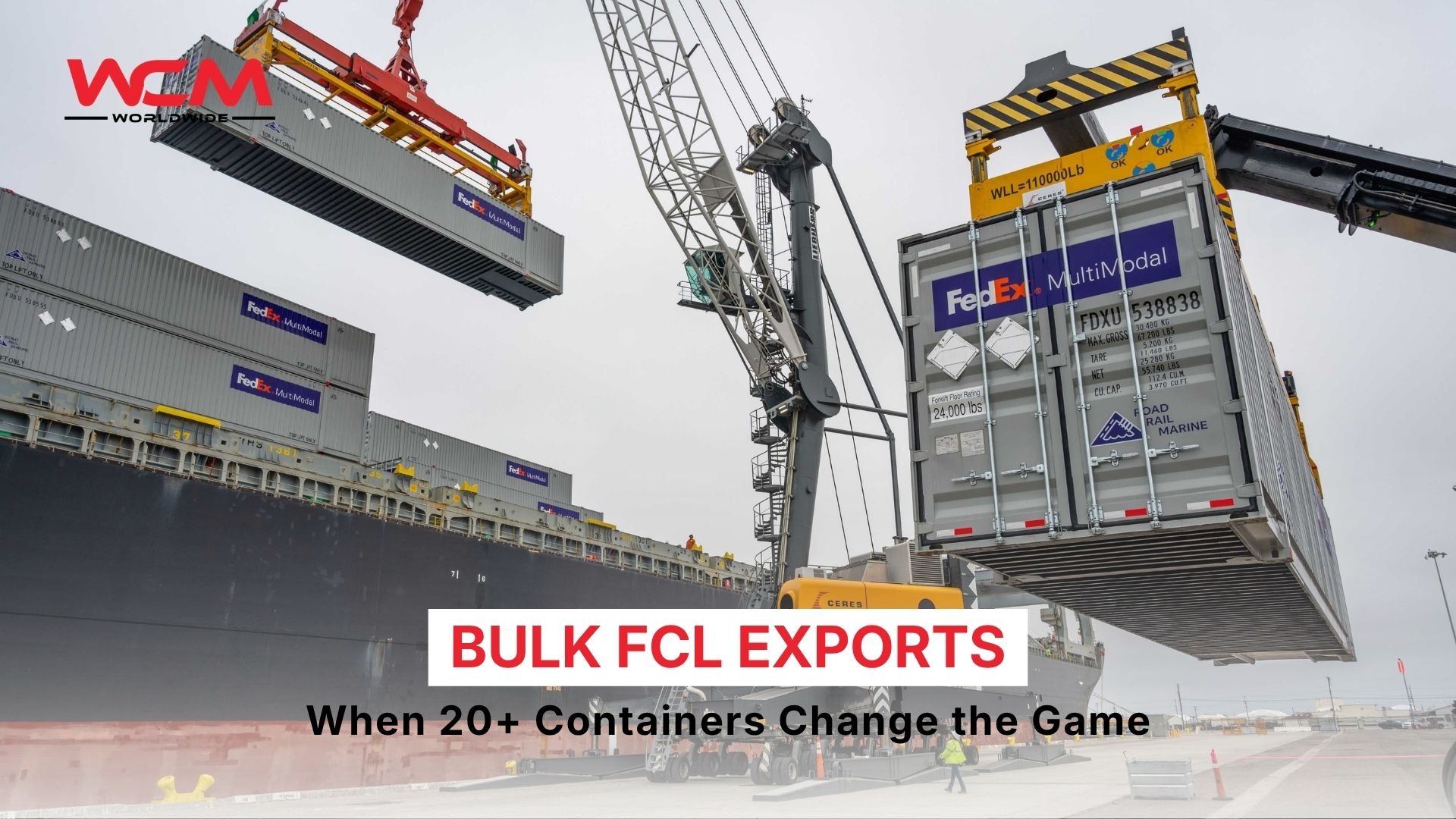
Most ocean freight content for US exporters is written for shippers booking one or two containers at a time. The conversation changes when the program is twenty or thirty containers per move and the export pattern is sustained across a calendar quarter. At that volume, freight stops being a quoting problem and starts being a contracting, allocation, and port operations problem at the same time.
Before structuring a bulk FCL export program from the USA, a few practical factors decide the right contracting structure:
- Sustained monthly or quarterly export volume across all destinations
- Number of origin ports the cargo loads through
- Number of destination ports and consignees in the program
- Carrier service contracts already in place and their allocation terms
- Sensitivity of the program to seasonal allocation tightness
- Cargo profile (commodity, weight, hazardous, refrigerated, project)
- Required transit times and reliability tolerance
- Internal team capacity for AES filings and carrier dispute work
At one or two containers per booking, ocean freight is a quoting problem. The shipper asks for a rate, books on a sailing that fits, and moves on. At twenty or thirty containers per move, the same shipper has stopped quoting and started negotiating. The program is now a contracting problem, a port operations problem, and a carrier relationship problem at the same time.
The shift is not gradual. It happens at a few specific thresholds where the economics, the operational complexity, and the right partner type all change at once. Bulk FCL exporters who design their freight program around the old quoting model carry costs and risks that a properly structured program would not generate.
WCM Worldwide operates bulk FCL export programs for US shippers as an FMC-licensed NVOCC with ocean freight service contracts across all major carriers.
The Threshold Where FCL Exports Become a Program
A small US exporter shipping one to five containers per month is genuinely working in the same operational world as a single-shipment importer. Rates are quoted per booking, carriers are selected by price or sailing convenience, and the freight is treated as a transaction. The freight bill is small relative to cargo value, and program efficiency does not pay back the planning cost.
At twenty containers per move, or sustained at fifty to one hundred containers per month, the equation changes. Carrier allocation under a service contract becomes worth negotiating. Origin port performance starts to drive freight reliability. The internal team handling AES filings, denied party screening, and carrier disputes becomes a defined function rather than a side task.
At the highest end of the spectrum, where a single move involves a full vessel or near-full vessel of containers, the program crosses into part charter and full charter territory. The contracting structure is no longer a service contract on a liner. It is a charter party for dedicated capacity.
The Four Shifts at the 20+ Container Level
Four operational realities change at the 20+ container threshold, and they change at the same time.
From spot booking to service contract allocation
A bulk FCL exporter on the spot market is a price taker. A bulk FCL exporter on a service contract has negotiated rates, committed allocation, and a contractual remedy if the carrier fails to deliver capacity. The transition from spot to contract is the single highest-leverage change in a bulk FCL program. The carriers that matter most to the program become long-term commercial partners rather than transactional suppliers.
From freight forwarder agent to NVOCC principal
A freight forwarder books cargo on existing carrier networks as the shipper's agent. An FMC-licensed NVOCC negotiates its own service contracts, issues its own House Bill of Lading, and assumes carrier responsibility under that contract of carriage. At higher volumes, the NVOCC contract portfolio can outperform a small or mid-size shipper's direct contract because the NVOCC aggregates volume across many shippers on the same lane.
From single-port routing to multi-port optimization
A 20+ container program rarely loads through one port. The freight cost difference between Charleston, Savannah, Houston, Los Angeles or Long Beach, Seattle or Tacoma, Norfolk, and New York or New Jersey for the same cargo on the same destination is material, and the right port choice depends on origin warehouse location, carrier service strings, and current congestion. The decision is not made once. It is made per move, against current conditions.
From per-shipment customs to programmatic compliance
At low volume, AES filings are individual events. At bulk volume, the AES, USMCA preference, denied party screening, and export control work become a continuous compliance discipline. The cost of a single misfiled AES is small. The cost of a pattern of misfilings across a year of shipments is large, and the visibility comes in the form of CBP penalties or BIS audits rather than freight invoices. A capable customs brokerage team handles the work inside the same operational program as the freight.
The Charter Crossover
Most bulk FCL export programs sit comfortably inside liner service. Twenty to thirty containers per move can move on a single sailing on most major trade lanes, and the program runs as a series of FCL bookings under a service contract. The math works.
At a certain volume, the math tips. When a single move involves a full vessel of containers or a near-full vessel, the per-container cost on a charter vessel can fall below the equivalent service contract rate. The decision is not only about cost. Schedule flexibility, dedicated capacity, port pairing freedom, and direct routing become available on charter that liner does not offer.
The crossover point varies by trade lane, cargo profile, and carrier market conditions. On most lanes it begins above two hundred containers in a single move. On capacity-constrained corridors or for specialized cargo, the crossover is lower. A bulk FCL exporter should know roughly where the crossover sits on its own lanes, and should review it each year as conditions change.
Origin Port Reality at the Major US Export Gateways
The US has roughly seven major export gateways for ocean freight, and the operational reality differs at each one. A bulk FCL program that uses two or three of them effectively will outperform a program that defaults to one.
| Gateway | Strength | Typical Trade Lane Focus |
|---|---|---|
| Charleston, SC | Containerized exports of agricultural products, automotive, and machinery; strong intermodal | Europe, Mediterranean, South Asia |
| Savannah, GA | Largest single-terminal container facility on the US East Coast; agricultural exports | Asia, Europe |
| Houston, TX | Gulf Coast hub; energy, petrochemicals, project cargo, breakbulk | Latin America, Europe, Asia |
| Los Angeles or Long Beach, CA | Largest US container port complex; broad commodity coverage | Asia |
| Seattle or Tacoma, WA | Pacific Northwest gateway; agricultural, machinery | Asia, especially Japan and Korea |
| Norfolk, VA | Naturally deep harbor; broad commodity coverage | Europe, Mediterranean |
| New York or New Jersey | Largest East Coast port complex; broad commodity coverage | Europe, Mediterranean |
A bulk FCL exporter should know which gateways serve its destination markets best, which carriers have the strongest service strings out of each, and which origin warehouses can feed each gateway efficiently. A program that uses only one gateway by default is leaving routing flexibility on the table.
Service Contract Economics
A service contract is a confidential, negotiated agreement between a shipper and an ocean carrier (or between a shipper and an NVOCC, or between an NVOCC and an ocean carrier) that fixes rates and commits minimum quantities over a defined period. The contract usually runs for a year, with rate adjustments tied to specific lane and cargo conditions. Allocation is the operational mechanism that makes the contract worth more than the rate sheet.
In a tight market, allocation determines whether cargo actually moves. A shipper with a contract has a contractual claim on a defined number of containers per week or per month on a given lane. A shipper without a contract competes for whatever space is left over after contracted volume is loaded. In the worst weeks of a tight market, that means no space at all.
An FMC-licensed NVOCC sits on the carrier side of multiple service contracts and on the shipper side of its own contracts with cargo owners. For a bulk FCL exporter that does not have the volume to negotiate strong direct contracts with each major carrier on each major lane, an NVOCC aggregated contract portfolio can provide better allocation and better rates than the exporter could secure alone.
How to Evaluate an Ocean Freight Partner for a Bulk FCL Export Program
Five criteria separate a partner that can execute a bulk FCL program from a partner that can quote one.
- FMC NVOCC licensing, verifiable on the FMC public Ocean Transportation Intermediary database
- Active service contracts with the major carriers serving the destination markets
- Demonstrated allocation performance through past market tightness, not just rate quotes
- Origin port capability across at least three of the major US export gateways
- AES filing, export control screening, and USMCA preference capability inside the same team that handles the freight
A partner that meets only two or three of these criteria will work for a small program. A partner that meets all five is the right structure for a sustained bulk FCL program at twenty or more containers per move.
Why Bulk FCL Export Programs Fail
Most bulk FCL export problems are preventable. The common failures include:
- Continuing to book on the spot market past the volume threshold where a service contract would pay back its negotiation cost
- Using one origin gateway by default rather than designing the program around the right gateway for each destination
- Treating allocation tightness as a freight rate problem rather than a contracting and relationship problem
- Splitting AES, export control filings, and customs work across separate vendors or internal teams with no clear data flow
- Underestimating the difference between a freight forwarder operating as an agent and an FMC NVOCC operating as a principal
- Missing the charter crossover on lanes where full or part charter would outperform service contract rates
- Treating the freight bill as the only cost line and overlooking AES penalties, demurrage and detention, and missed allocation on subsequent shipments
- Assuming carrier loyalty in a tight market without a contractual basis for that loyalty
These failures rarely appear as a single dramatic event. They compound. A spot-market booking pattern combines with a one-gateway routing default and a freight forwarder relationship that has no allocation leverage, and the program quietly underperforms the market while the freight invoices look reasonable on their own.
How WCM Worldwide Handles Bulk FCL Exports
WCM operates bulk FCL exports as a contracted, multi-gateway program built around carrier allocation rather than per-shipment rate quoting.
- FMC-licensed NVOCC ocean freight with service contracts across all major ocean carriers, verifiable on the FMC public Ocean Transportation Intermediary database
- Multi-gateway routing across Charleston, Savannah, Houston, Los Angeles or Long Beach, Seattle or Tacoma, Norfolk, and New York or New Jersey
- Service contract structure that aggregates shipper volume across multiple cargo owners and trade lanes, providing rate and allocation leverage that small and mid-size shippers cannot generate alone
- Charter and part charter capability for moves that cross the threshold where dedicated vessel capacity outperforms liner service
- US customs and AES filing handled inside the same workflow as the freight booking, reducing the data handoff failures that drive compliance penalties
- Buyer's consolidation, foreign-to-foreign moves, and PO management available under one operational structure for shippers that have both inbound and outbound flows
- A global network of 496 offices in 97 countries, providing destination-side support for consignees rather than only origin-side handling
The value of this structure is that service contracts, port routing, customs filings, and allocation performance sit inside one accountable team rather than across separate vendors. WCM's leadership team carries 100+ years of combined experience built at FedEx Logistics, CEVA, COSCO, CMA CGM, and Kuehne+Nagel, with senior procurement leadership that includes Jim Rinchiuso, the former Managing Director of Global Ocean at FedEx Logistics. Bulk FCL programs behave better when the people running the contract portfolio have already negotiated through multiple market cycles.
Final Considerations for US Bulk FCL Exporters
Bulk FCL exports become a different logistics problem at the volume where service contracts, allocation, and multi-gateway routing start to matter. A program that ignores these dynamics will pay for the gap in lost reliability, in lost allocation during tight markets, and in compliance exposure that does not appear on the freight invoice.
A practical checklist for evaluating a bulk FCL export program:
- Is the program structured around service contracts with carriers, or booked on the spot market?
- Is the partner an FMC-licensed NVOCC operating as a principal, or a freight forwarder operating as an agent?
- Does the routing use multiple US export gateways, or default to one?
- Are AES filings, export control screening, and USMCA preference handled inside the freight workflow or by a separate team?
- Has charter or part charter been evaluated against service contract rates on the highest-volume lanes?
If you operate a US export program at twenty or more containers per move, or at sustained monthly volume that crosses fifty to one hundred containers, the WCM ocean freight team can review your current program against the four shifts above. Share trade lanes, monthly volume, current carrier relationships, and current pain points with the WCM ocean freight team to start the conversation.
Frequently Asked Questions
At what volume does bulk FCL export shipping become a different logistics problem?
The shift typically begins at sustained monthly volume above fifty containers, or at single-move volume above twenty containers on the same destination. At those thresholds, service contracts with carriers start to pay back their negotiation cost, multi-gateway routing becomes worth designing around, and the internal compliance work for AES filings and export controls becomes a continuous discipline rather than a per-shipment task. Programs that ignore these thresholds keep operating on spot-market rates and single-gateway routing that work at low volume but underperform at scale.
What is the difference between a freight forwarder and an NVOCC for bulk FCL exports?
A freight forwarder books cargo on existing carrier networks as the shipper's agent, with no carrier responsibility of its own. An FMC-licensed NVOCC negotiates its own service contracts with ocean carriers, issues its own House Bill of Lading, and assumes carrier responsibility under that contract of carriage. For a bulk FCL exporter, the NVOCC contract portfolio aggregates volume across multiple shippers on the same lane, which often produces better rates and better allocation than a small or mid-size shipper can negotiate directly.
Why does origin port choice matter for a bulk FCL export program?
The US has roughly seven major export gateways, and each has different strengths in carrier service strings, intermodal connectivity, and current congestion levels. The freight cost difference between gateways on the same destination can be material, and the right gateway for a given move depends on origin warehouse location, carrier service to the destination, and current operational conditions. A bulk FCL program that defaults to one gateway is leaving routing flexibility, and freight cost, on the table.
When should a bulk FCL exporter consider chartering a vessel?
The charter crossover begins when a single move involves a full vessel or near-full vessel of containers, typically above two hundred containers on most lanes, with lower thresholds on capacity-constrained corridors. At that volume, charter rates per container can fall below service contract rates, and charter offers schedule flexibility, dedicated capacity, and direct routing that liner service does not. The decision is reviewed each year against current carrier market conditions, since the crossover point moves with the market.
What service contract terms matter most for bulk FCL exporters?
Rate is the most visible term, but allocation is usually more important. A bulk FCL exporter needs a contractual right to a defined number of containers per week or per month on a given lane, with a documented remedy if the carrier fails to deliver capacity. Cargo categories, equipment types, free time, and termination provisions also matter, and an experienced ocean freight partner negotiates these terms as a package rather than focusing only on the headline rate.
How does an NVOCC handle US export compliance for a bulk FCL program?
An FMC-licensed NVOCC with US customs brokerage capability handles AES filings, denied party screening, export control compliance, and USMCA preference work inside the same workflow as the freight booking. The advantage is that the data needed for compliance comes from the same source as the data on the booking, so the handoff failures that drive AES penalties and BIS audit exposure are reduced. The compliance work is also accountable to the same team that handles allocation and routing, not subcontracted out.