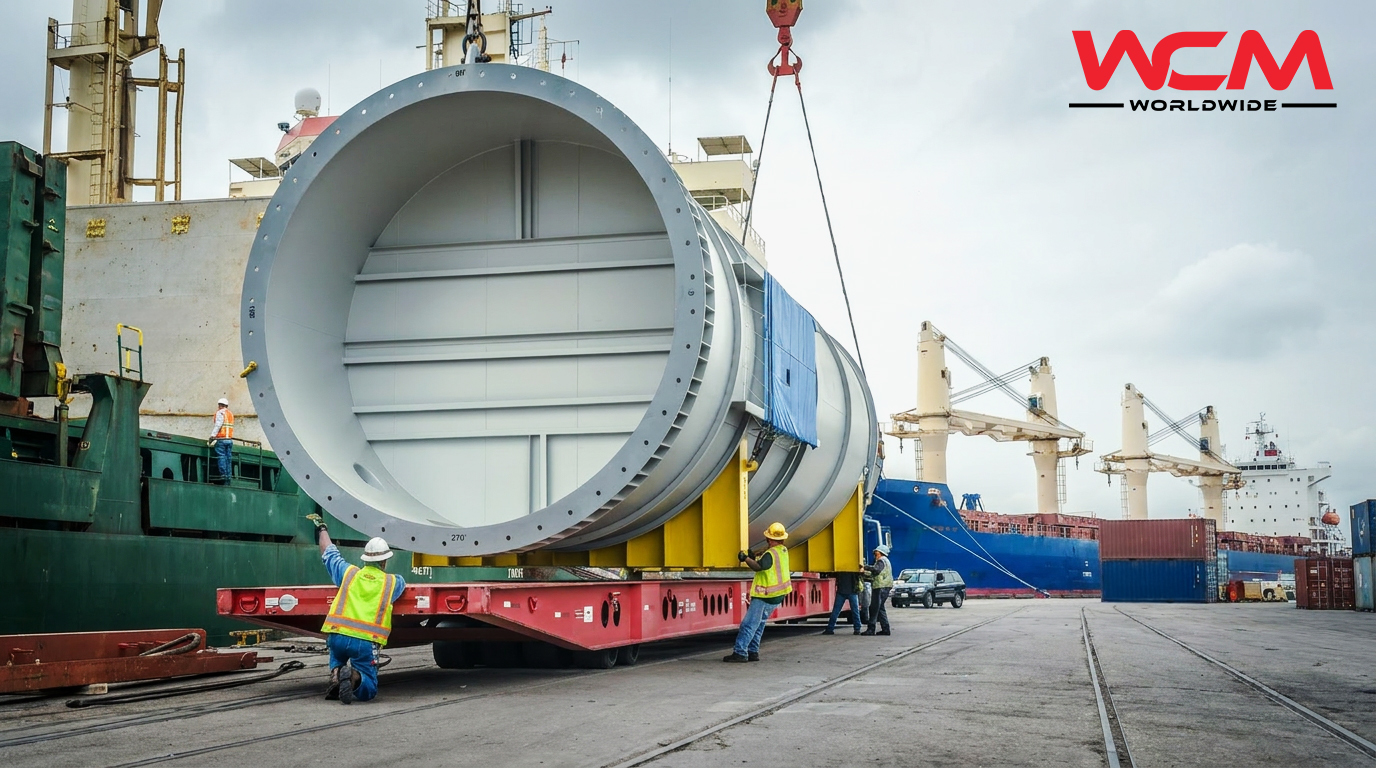
Project Cargo
For a mine located inland, an on time arrival at the port means nothing if the cargo cannot cross the final bridge or be supported by the interior infrastructure.
That is where heavy lift mining logistics becomes unforgiving. A carrier may accept the cargo. A port may discharge it. A customs entry may clear. But if the final route cannot take the weight, if the receiving site has no crane window, or if the border crossing cannot process an oversized move, the shipment is still stuck.
This is why heavy lift cargo for remote mining sites cannot be planned like ordinary freight with bigger equipment. The move has to be built backward from the mine gate.
The real question is not, “Can someone move this cargo?”
The real question is, “Can every mile, lift, permit, border, staging point, and receiving condition be proven before the cargo leaves origin?”
For mining operators, procurement teams, and industrial shippers, that difference determines whether a critical component reaches the site or becomes an expensive problem sitting in the wrong place. This is the type of movement where WCM Worldwide’s Mining, Breakbulk and Project Cargo, and Special Projects capabilities become central to the plan, because the cargo, the route, and the site conditions have to be solved together.
When standard carrier service is the wrong model
Standard carrier service works when cargo fits predictable networks. Remote mining cargo rarely does.
Mining equipment, grinding media, plant components, oversized machinery, crushers, mill parts, transformers, and heavy industrial units can create problems that standard freight models are not designed to solve.
The issue is not only size or weight. The issue is incompatibility with normal operating limits.
| Constraint | What can go wrong |
|---|---|
| Cargo is too heavy | Standard chassis, bridges, cranes, or road surfaces may not support the load |
| Cargo is too wide or tall | Roads, gates, wires, tunnels, turns, and border crossings may block the route |
| Cargo is irregularly shaped | Normal lifting, lashing, and securing methods may not apply |
| Destination is remote | The final miles may have limited road quality, weather exposure, or no nearby support |
| Multiple borders are involved | Customs, permits, and oversize approvals can become the main source of delay |
| Site receiving is limited | The mine may not be ready to unload, stage, or install the cargo when it arrives |
A standard freight booking asks which carrier can take the shipment.
A mining project cargo plan asks whether the cargo can survive the full journey from supplier floor to mine site.
That is why WCM’s breakbulk and mining logistics support is not just about finding transport capacity. It is about matching the cargo with the correct handling method, port plan, inland routing, cross border process, and final site delivery model.
Start with the receiving site, not the vessel
The most common planning mistake is starting with the ocean move because it looks like the largest part of the shipment.
For remote mining cargo, the final destination should come first.
Before choosing a port, vessel, trailer, or route, the receiving site must answer practical questions:
| Site question | Why it matters |
|---|---|
| Where exactly will the cargo be unloaded? | Determines crane access, turning radius, surface strength, and staging needs |
| Can the site receive the cargo on the planned date? | Prevents equipment from arriving before the mine is ready |
| Is unloading equipment available on site? | Avoids a delivery with no safe way to discharge |
| Is the access road usable for the cargo size and weight? | Prevents last mile failure after successful port discharge |
| Is the route seasonal? | Avoids rain, snow, washout, or closure related delays |
| Is there space to stage cargo if installation is delayed? | Prevents rushed handling or unsafe storage |
If the mine site cannot receive the cargo, the rest of the plan is incomplete.
The vessel schedule should not drive the move. The mine gate should.
WCM’s mining logistics approach is especially relevant here because remote mine movements often need more than port to port freight. They may require charter or part charter planning, heavy haul coordination, transload support, border movement, site readiness checks, and inventory timing so cargo reaches the operation when it can actually be received.
Build a cargo file before asking for transport options
Heavy lift cargo should not be quoted from a vague description. “Large machine part” is not enough. “Oversized equipment” is not enough.
A usable cargo file should include:
| Required detail | Why it matters |
|---|---|
| Final length, width, height, and gross weight | Determines transport mode and equipment limits |
| Center of gravity | Affects lifting, trailer selection, and cargo stability |
| Lifting points | Determines crane plan and rigging method |
| Packing or skid design | Affects handling, weather protection, and inland movement |
| Tie down points | Supports safe lashing and securing |
| Photos and drawings | Helps carriers, ports, crane teams, and heavy haul providers assess feasibility |
| Delivery priority | Determines whether scheduled service, breakbulk, part charter, or charter is realistic |
| Site unloading plan | Confirms whether the cargo can be received safely |
Without this file, pricing is guesswork. Worse, the shipment may be accepted by one party and rejected by another later in the chain.
That is how cargo ends up stranded at port.
For WCM, this early cargo review is where the right service path starts to become clear. Some cargo can move through Ocean Freight solutions with specialized handling. Other cargo may need breakbulk planning, a charter market option, transloading, warehousing, or a dedicated special project movement.
Choose the port for capability, not distance
The nearest port is often not the best port.
For mining cargo, a port should be selected based on what it can physically handle and what inland route it opens up.
A port that is closer to the mine may still be the wrong choice if it lacks heavy lift crane capacity, laydown space, breakbulk experience, customs support, bonded movement options, or reliable heavy haul access.
A farther port may reduce total risk if it offers better discharge conditions and a stronger inland corridor.
| Port factor | What to verify |
|---|---|
| Heavy lift handling | Can the terminal safely discharge the cargo? |
| Crane availability | Is the right crane available during the vessel window? |
| Laydown space | Can cargo be staged, inspected, or reloaded safely? |
| Breakbulk handling experience | Can the port manage non containerized cargo without improvisation? |
| Customs readiness | Can documents and clearance be prepared before arrival? |
| Inland access | Does the route from the port support the cargo profile? |
| Storage limits | What happens if permits or site readiness are delayed? |
A good port decision reduces risk after discharge. A bad port decision simply moves the problem inland.
This is where WCM’s project cargo experience matters. The correct port decision has to account for vessel discharge, shore equipment, cargo staging, inland transport, customs timing, and the realities of the mine site, not only the port closest on a map.
Select the transport model based on failure points
The mode should be chosen only after the weak points are known.
| Option | When it makes sense |
|---|---|
| Flat rack or open top | Cargo is oversized but still manageable through container terminals |
| RoRo | Machinery can roll or be towed on and off the vessel |
| Breakbulk | Cargo is too large, heavy, or irregular for container handling |
| Part charter | Several project pieces need controlled vessel space without taking a full vessel |
| Full charter | Cargo, schedule, port access, or discharge conditions require dedicated vessel planning |
| Air charter | Time critical components must move faster than ocean service allows |
No mode is automatically superior. The right mode is the one that removes the biggest execution risk.
For example, breakbulk may solve a lifting problem but create a port handling requirement. A flat rack may reduce cost but still fail if the cargo cannot move inland. A charter may look expensive but protect a shutdown timeline when production impact matters more than freight cost.
WCM’s value in this stage is the ability to evaluate the move across multiple transport models instead of forcing the cargo into a standard carrier option. For mining and industrial cargo, that flexibility can be the difference between a shipment that looks cheaper on paper and a movement that actually reaches the site.
Prove the inland route before cargo departure
The inland route is where remote mining moves become difficult.
A route survey should not be treated as a formality. It is the difference between a feasible move and a cargo unit trapped between port and site.
The inland review should verify:
| Route item | Risk if ignored |
|---|---|
| Bridge capacity | Loaded trailer may exceed safe limits |
| Road width | Cargo may not clear turns, villages, gates, or narrow corridors |
| Height clearance | Wires, signs, overpasses, and trees may block passage |
| Surface condition | Remote roads may fail under weight or weather |
| Gradient and turning radius | Heavy cargo may not manage slopes or tight turns |
| Escort requirements | Movement may be illegal or unsafe without escorts |
| Travel time restrictions | Permits may limit movement to certain hours or days |
| Refueling and support access | Remote corridors may lack recovery options |
| Border capability | The crossing may not accept oversized cargo or heavy haul equipment |
This review must happen before the cargo moves, not after it reaches the destination port.
WCM’s Logistics capabilities are relevant here because remote movements may need multimodal planning, special equipment, limited infrastructure routing, and final mile coordination beyond standard truckload or containerized freight.
Treat permits and customs as route controls
Permits and customs documents are not paperwork sitting beside the logistics plan. They are part of the route.
An oversized move may be physically possible but legally blocked. A shipment may be customs cleared at port but unable to cross an inland border. A heavy haul permit may require a different route than the one originally quoted.
For remote mining cargo, teams should confirm:
| Requirement | Why it matters |
|---|---|
| Import documentation | Prevents port holds and customs delays |
| HS classification | Reduces classification disputes and clearance risk |
| Oversize permits | Determines approved route and travel timing |
| Escort approvals | May be required for public road movement |
| Bonded movement | May be needed before final customs release |
| Border crossing selection | Not every crossing can handle oversized cargo |
| Local consignee readiness | Prevents delays caused by incomplete receiving instructions |
If permits are handled after booking, the logistics plan is already behind.
For oversized mining cargo that crosses borders, WCM’s Cross Border and customs coordination capabilities help connect the legal movement of the cargo with the physical movement of the cargo. That connection is critical because a route is only useful if the cargo is allowed to move through it.
Use staging when direct delivery creates risk
Direct delivery sounds efficient. It is not always the safest choice.
A controlled staging point can protect the shipment when the mine is not ready, the road window is uncertain, customs timing is unstable, or several cargo units need to arrive in a specific sequence.
Staging can help when:
| Situation | Why staging helps |
|---|---|
| Cargo arrives before site readiness | Avoids port storage and rushed delivery |
| Final road access is weather dependent | Holds cargo near the route until conditions improve |
| Installation sequence matters | Delivers components in the order the site needs them |
| Cargo needs inspection after discharge | Identifies damage before remote movement |
| Inland equipment differs from port equipment | Allows proper reloading onto heavy haul units |
| Border timing is uncertain | Keeps cargo controlled while approvals are completed |
For mining logistics, staging is not delay. When planned properly, it is risk control.
WCM’s Warehousing, transloading, receiving, storage, and cross docking capabilities can support this stage when cargo needs to be held, inspected, resequenced, or prepared for final movement into the mine site.
The final mile is the real test
A heavy lift mining shipment is successful only when the cargo is safely received at the site.
The final mile must confirm:
| Final mile item | What must be ready |
|---|---|
| Access road | Clear, stable, and suitable for loaded movement |
| Mine gate clearance | Wide enough for cargo and equipment |
| Turning area | Adequate for trailer positioning |
| Ground bearing capacity | Strong enough for trailer, crane, and cargo |
| Unloading equipment | Available and matched to cargo weight and lift points |
| Site crew | Ready during the delivery window |
| Temporary storage | Available if installation is delayed |
| Emergency plan | Prepared for breakdown, weather, or access interruption |
This is where many low cost plans collapse. They price the long distance move but underestimate the last few miles.
For WCM, the final mile is not separate from the freight plan. It is part of the same project cargo decision, especially when oversized cargo, heavy machinery, mining equipment, grinding media, or critical components must reach a remote operating site without forcing last minute improvisation.
Decision framework for mining teams
Before approving any heavy lift move to a remote mining site, ask these questions:
| Question | What the answer should prove |
|---|---|
| Can the cargo be safely lifted, secured, and handled? | Cargo engineering is complete |
| Can the discharge port handle the cargo? | Port feasibility is confirmed |
| Can the inland route support the loaded movement? | Road, bridge, clearance, and permit risks are known |
| Can customs and border approvals be completed before arrival? | Regulatory risk is controlled |
| Can the mine site receive the cargo on schedule? | Final mile and unloading readiness are confirmed |
| Is there a staging or contingency plan? | The move can adapt if conditions change |
If any answer is unclear, the shipment is not ready to move.
This is also the point where a specialist logistics partner should be involved early. WCM’s role is not limited to carrier booking. It brings together mining cargo planning, breakbulk and project cargo coordination, ocean freight options, cross border movement, warehousing or staging, customs support, and special project handling into one practical movement plan.
Final takeaway
- Remote mining cargo should be planned from the mine site backward.
- Start with the receiving point. Then prove the access road, inland corridor, permits, border process, discharge port, lifting plan, and ocean option.
- That order matters because heavy lift cargo does not fail only in transit. It fails at the point where one assumption was left unchecked.
- For mining companies moving heavy machinery, grinding media, plant equipment, oversized components, or project cargo into remote sites, the safest plan is the one that identifies every physical and regulatory constraint before the shipment leaves origin.
- When standard carrier services cannot handle the cargo, the answer is not to keep looking for a cheaper carrier. The answer is to build a logistics plan around the cargo, the route, the permits, the equipment, and the mine site reality.
If your next shipment involves out of gauge cargo, oversized machinery, heavy lift components, or remote site delivery, schedule a call with the WCM Worldwide team to discuss the cargo profile, routing challenges, equipment requirements, and safest movement plan before the shipment is booked.