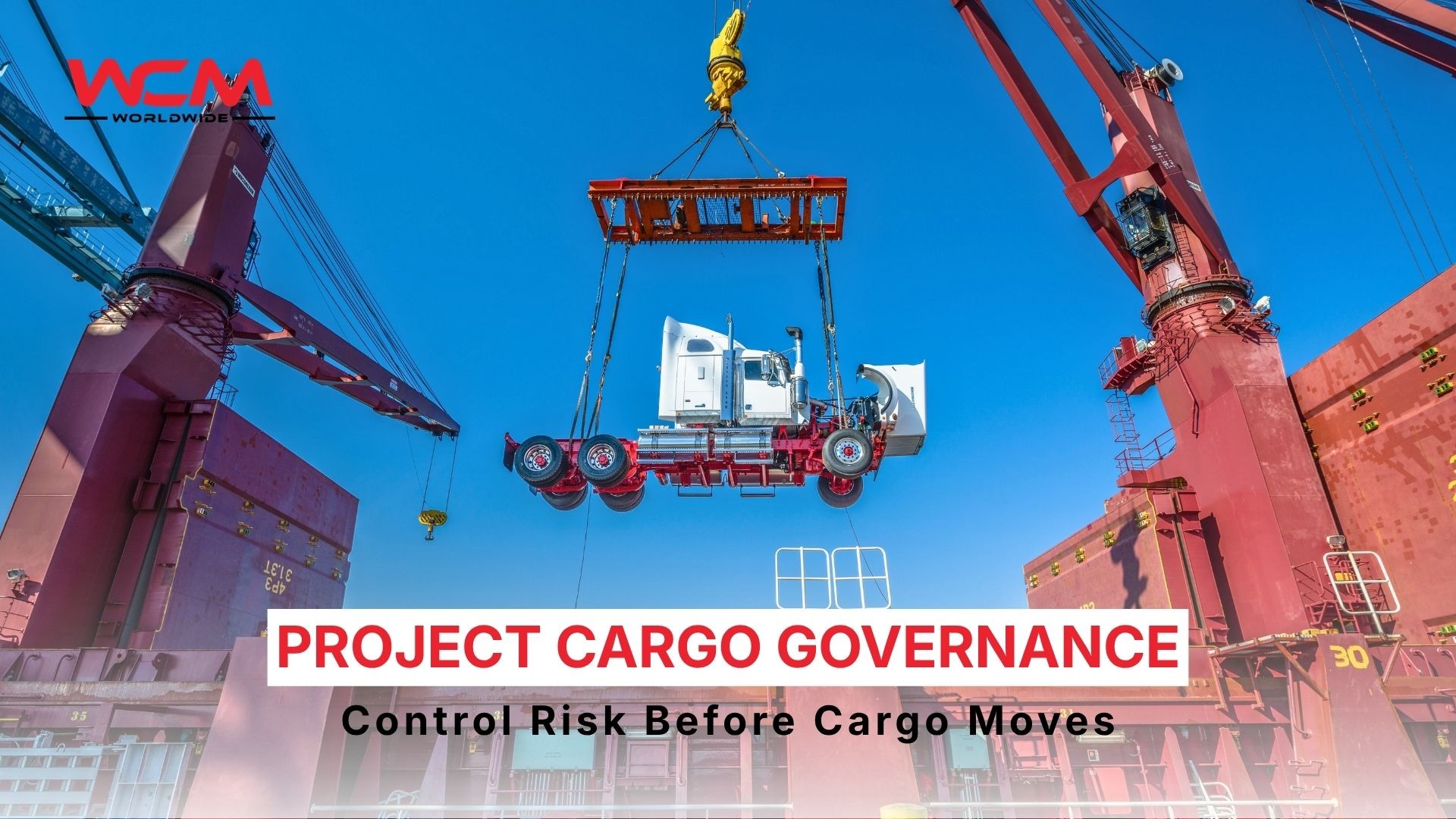
Project cargo governance is the structure an enterprise puts around a heavy lift, breakbulk, or out-of-gauge move so that the engagement can be controlled, audited, and held accountable. Hiring a capable project cargo forwarder is necessary but not sufficient. The governance structure is what determines whether the project actually controls the move or merely outsources it.
Before signing a project cargo engagement, a few governance factors decide whether the enterprise will retain control of the move:
- Scope of work design and the decision authority handoffs between enterprise and forwarder
- Decision gates that release the move from one stage to the next
- KPIs by which the forwarder will be measured during and after execution
- Dual-control authority on charter party signature and binding commercial decisions
- Audit and documentation hygiene standards across the engagement
- Independence of the marine warranty surveyor from the forwarder
- Escalation path when the move slips or the forwarder requests scope changes
- Post-delivery audit protocol and lessons-learned documentation
Enterprises hire competent project cargo forwarders and still lose control. The forwarder executes the move technically well, but the enterprise has no visibility into critical decisions, no audit trail when something slips, and no mechanism to enforce performance against the contract. The freight arrives. The governance gap shows up later, in the post-mortem.
Governance is the buyer's discipline, not the forwarder's. A capable forwarder welcomes a well-governed engagement because the structure is clear, decisions are documented, and disputes have a recorded basis. A weakly-governed engagement is harder to execute well even with the right partner, and is unrecoverable with the wrong one.
WCM Worldwide operates project cargo engagements with the governance structures that procurement and audit teams expect across its breakbulk and project cargo and special projects practice.
What Project Cargo Governance Actually Means
Project cargo governance is the framework an enterprise builds around a complex freight move to control four things: the scope of decisions delegated to the forwarder, the gates at which control returns to the enterprise, the measurements by which performance is judged, and the audit trail that documents what happened and why.
It is distinct from operational execution. The forwarder runs the move. Governance is how the enterprise stays in command of the program while the forwarder runs the move. The two are not in tension. Strong governance and strong execution reinforce each other.
A governed project cargo engagement looks different from an un-governed one in three visible ways. Decisions are documented before they are made, not after. Performance is measured against pre-agreed criteria, not in retrospect. And disputes have a procedural path that does not depend on goodwill or recall.
The Four Disciplines That Need Governance
A project cargo engagement covers four operational disciplines, and each needs its own governance treatment. Treating the engagement as a single delegation is the most common procurement error in project cargo.
Engineering governance
Cargo engineering data drives every downstream decision in the move. The governance question is who owns the engineering data, who signs off on it, and who is accountable if it turns out to be wrong. Strong engagements require the forwarder's cargo engineer to issue a sealed data sheet against which all subsequent vessel, port, and route decisions are made, with revisions tracked formally and signed by both the forwarder and the enterprise project sponsor.
Chartering governance
Charter party signature commits the enterprise to a vessel, a route, a payment schedule, and a liability allocation that often runs to tens of millions of dollars. The governance question is who has authority to bind the enterprise. Strong engagements require dual-control authority on charter signature, with the forwarder negotiating and the enterprise or its independent counsel approving the final charter party language before it is fixed.
Port handling governance
Port operations involve berth allocation, crane and stevedoring contracts, surveying and lashing, customs filings, and the physical lift of the cargo. The governance question is who is accountable for port performance and who pays when port problems delay the move. Strong engagements name a single forwarder-side port captain at each major port, define what counts as a port-caused delay versus a vessel-caused delay, and document the demurrage and detention recovery process.
Inland delivery governance
The inland leg is where most project cargo schedules slip. The governance question is what happens when the route survey identifies a constraint that needs civil works such as bridge reinforcement, road widening, or escort permitting that takes longer than expected, and who pays for the change. Strong engagements require the forwarder to surface inland constraints at the engineering stage, not at the port, with a documented change-order process when constraints emerge later.
Decision Gates That Should Exist in Every Project Cargo Engagement
A decision gate is a structured pause in the program at which control returns to the enterprise, a defined set of artifacts is reviewed, and an explicit approval is required before the next stage begins. Five gates belong in any enterprise project cargo engagement.
| Decision Gate | Stage of Move | Required Artifacts | Approval Authority |
|---|---|---|---|
| Engineering approval | Pre-booking | Sealed cargo data sheet, route concept, vessel class shortlist | Project sponsor and forwarder cargo engineer |
| Charter fixture | Pre-vessel commitment | Negotiated charter party, rider clauses, payment schedule | Procurement, legal, and forwarder |
| Port readiness | Pre-loading | Berth confirmation, crane capacity confirmation, lashing plan, surveyor engagement | Forwarder port captain and project manager |
| Inland release | Pre-discharge | Route survey sign-off, permits in hand, escort confirmation, destination customs cleared | Forwarder operations and destination team |
| On-site handover | At installation site | Cargo condition survey, damage claims if any, delivery acknowledgment | Enterprise site manager and forwarder |
The gates are not bureaucracy. Each one captures a specific moment when control over the move can be lost if the gate is skipped. Skipping the chartering gate means the enterprise has committed to a vessel and route it has not reviewed. Skipping the inland release gate means the cargo lands at the port without confirmation that it can actually move to the site.
KPIs That Actually Measure Project Cargo Performance
Project cargo performance is rarely captured by freight cost per ton. That metric measures the wrong thing. Five KPIs measure what enterprises actually care about across the lifecycle of the move.
- Milestone hit rate, which is the percentage of contractual milestones (engineering sign-off, vessel nomination, port arrival, on-site delivery) that hit the target date without re-scoping
- Documentation accuracy, which is the percentage of cargo documentation (bill of lading, certificate of origin, packing list, surveyor reports) that does not require post-issue correction
- Claim incidence and value, covering the count and dollar value of cargo damage and delay claims per move
- Change order frequency, the count of forwarder-initiated scope changes during the engagement
- Schedule recovery time, the average time from a missed milestone to a re-baseline that the enterprise accepts
The KPIs are tracked through the engagement, not measured only at the end. A KPI that surfaces only in the post-delivery audit is too late to act on. Strong engagements review the KPIs monthly during execution and at every decision gate.
Where Control Breaks Down Even With a Competent Forwarder
Most project cargo control failures share a small set of patterns. Recognizing the pattern early is the difference between a recoverable governance gap and a delivered-but-unauditable move.
Verbal scope changes
The forwarder asks for a routing change, a vessel substitution, or a port swap by phone, the project manager agrees, and the contract is never updated. When the move slips later, the basis for accountability is missing. Strong engagements require written change requests with documented approval, even when the timeline is tight.
Schedule slippage absorbed as overtime
The cargo is two weeks behind schedule, but the project absorbs the delay by running overtime on construction, and no one re-baselines the freight schedule formally. The next forwarder engagement starts from a corrupted baseline because the slippage is undocumented. The forwarder's actual performance is never measured against the original schedule.
Charter party signature without dual control
The forwarder presents the charter party for signature with no time for enterprise review, citing market conditions. The signature happens, the vessel is fixed, and the enterprise discovers later that liability allocation, payment terms, or cancellation rights are not what it would have agreed to. Dual control on charter signature is the single most leveraged governance protection.
Surveyor engaged through the forwarder
The forwarder engages the marine warranty surveyor and pays the invoice. The surveyor reports to the cargo insurance underwriter on paper but is operationally aligned with the party paying. Strong engagements require the enterprise to engage the surveyor directly, or to confirm the surveyor's independence in writing before the engagement starts.
Marine Warranty Surveyor Independence
Marine warranty surveyors verify cargo condition, approve lashing arrangements, and certify load and discharge operations for the cargo insurance underwriter. Their independence is what makes their certification meaningful. When the surveyor reports to the same party they are surveying, the certification is weakened.
Three protections matter. The surveyor should be engaged and paid directly by the enterprise or the cargo insurance underwriter, not by the forwarder. The surveyor's reports should be delivered simultaneously to the enterprise and the forwarder, not filtered through the forwarder. And the surveyor should have a clear escalation path that does not require forwarder cooperation.
These are not adversarial protections. They are protections that a competent forwarder welcomes because they reduce the forwarder's own exposure if a cargo claim is later disputed. The presence of an independent surveyor is one of the strongest signals that an engagement is well governed.
Why Project Cargo Governance Engagements Fail
Most project cargo governance problems are preventable. The common failures include:
- Treating the engagement as a single delegation rather than a multi-discipline program with distinct governance requirements at each stage
- Skipping decision gates under time pressure, then losing visibility into what was approved and what was not
- Allowing the forwarder to sign the charter party without enterprise review and dual authorization
- Measuring forwarder performance only on freight cost per ton, missing schedule, documentation, and claim metrics that matter more
- Engaging the marine warranty surveyor through the forwarder rather than independently, weakening the certification
- Absorbing schedule slippage into construction overtime without re-baselining the freight schedule
- Approving forwarder change requests verbally during execution without written documentation
- Running the post-delivery audit only when something has gone wrong, rather than as a standard closure protocol
These failures rarely appear as a single dramatic event. They compound. A verbal change request combines with an absorbed schedule slip and a dependent surveyor, and by the time the post-mortem starts, the audit trail will not support an accountability claim that the forwarder would otherwise be obligated to honor.
How WCM Worldwide Handles Project Cargo Governance
WCM operates project cargo engagements with governance structures that procurement, audit, and project sponsor teams can rely on across the full move.
- A sealed cargo data sheet issued by the WCM cargo engineering team at the engineering stage, with formal revision control and joint sign-off
- Charter party negotiation with the enterprise legal or procurement counsel in the loop, supporting dual-control authority on the binding signature
- Decision gates at engineering approval, charter fixture, port readiness, inland release, and on-site handover, with documented artifacts required at each gate
- Performance KPIs covering milestone hit rate, documentation accuracy, claim incidence, change order frequency, and schedule recovery time, reviewed monthly during execution
- Port operations coordinated through named WCM port captains at each major load and discharge port, with clear accountability for port-caused delays
- Inland transport engineered through route surveys, permit lead times, and escort planning at the front end, with documented change-order discipline when constraints emerge later
- Marine warranty surveyor independence protected by engaging the surveyor through the enterprise or insurance underwriter, with simultaneous reporting to both parties
- Post-delivery audit and lessons-learned documentation issued as a standard closure protocol, not only when something has gone wrong
- FMC-licensed NVOCC ocean freight and US customs brokerage operated under one accountable team rather than across separate vendors
The value of this structure is that procurement and project sponsor teams can audit the engagement at any point and find the artifacts they need. WCM's leadership team carries 100+ years of combined experience built at FedEx Logistics, CEVA, COSCO, CMA CGM, and Kuehne+Nagel, including direct project cargo work on heavy lift moves where the governance discipline determined whether the project recovered from a constraint or absorbed the delay. Strong governance is not a slower way to execute. It is the discipline that makes the execution defensible.
Final Considerations for Procurement and Project Sponsors
Project cargo governance matters most when the move involves multi-million-dollar cargo, critical-path schedules, complex liability allocation, and audit exposure. The engagement either runs under a governance structure that captures decisions and measures performance, or it runs on goodwill that has no audit trail when the project closes.
A practical checklist for evaluating governance on a current or planned project cargo engagement:
- Does the engagement have explicit decision gates with required artifacts at each gate?
- Is dual-control authority required for charter party signature?
- Are performance KPIs defined in the scope of work, not added during execution?
- Is the marine warranty surveyor engaged independently of the forwarder?
- Is there a documented change-order process for verbal forwarder requests during execution?
- Is a post-delivery audit a standard closure step, not a contingent response to a problem?
If your project involves heavy lift, out-of-gauge, or breakbulk cargo with material commercial exposure, the WCM team can review your current governance structure against the framework above. The conversation typically starts with scope of work, decision authority handoffs, and KPIs that the engagement should be measured against. Reach out through the WCM project cargo team to discuss the right governance structure for your move.
Frequently Asked Questions
What is project cargo governance?
Project cargo governance is the structure an enterprise puts around a heavy lift, breakbulk, or out-of-gauge freight engagement to control decisions, measure performance, and maintain an audit trail. It covers scope of work design, decision gates, KPIs, authority allocation on binding decisions like charter party signature, and post-delivery audit. Governance is distinct from operational execution and is the buyer's discipline rather than the forwarder's.
How is project cargo governance different from project cargo forwarding?
Project cargo forwarding is the operational discipline of executing the move, including cargo engineering, vessel selection, charter contracting, port operations, and inland transport. Project cargo governance is the framework the enterprise builds around the engagement to control the forwarder's decisions, measure performance, and document the basis for accountability. A capable forwarder executes the move. Strong governance is what allows the enterprise to remain in control of the program while the forwarder executes.
What decision gates should every project cargo engagement have?
Five gates belong in any enterprise project cargo engagement: engineering approval, charter fixture, port readiness, inland release, and on-site handover. Each gate releases the move from one stage to the next, requires a defined set of artifacts to be reviewed, and requires explicit approval from named authorities on both the enterprise and forwarder side. Skipping a gate under time pressure is one of the most common governance failures, since it removes the documentation that would otherwise support accountability later.
What KPIs should I use to measure a project cargo forwarder?
Freight cost per ton is not the most useful project cargo KPI. The metrics that matter for enterprise governance are milestone hit rate, documentation accuracy, claim incidence and value, change order frequency, and schedule recovery time when a milestone is missed. These KPIs are tracked monthly during execution rather than measured only at the post-delivery audit, which is too late to act on a performance issue.
Why does marine warranty surveyor independence matter?
Marine warranty surveyors verify cargo condition, approve lashing, and certify load and discharge operations for the cargo insurance underwriter. Their certification is meaningful only when they are independent of the party they are surveying. When the surveyor is engaged and paid by the forwarder, the certification is weakened, and a cargo claim that turns on surveyor judgment becomes contestable. Strong engagements engage the surveyor through the enterprise or the insurance underwriter directly, with simultaneous reporting to all parties.
What should be in a project cargo scope of work?
A scope of work that supports governance covers more than the freight scope. It defines the decision gates, the artifacts required at each gate, the authority on binding decisions like charter party signature, the performance KPIs, the change-order process, the marine warranty surveyor engagement structure, and the post-delivery audit protocol. The freight execution provisions sit inside that framework. Scopes that cover only the freight scope without the governance framework leave the enterprise with no procedural basis for accountability when execution slips.