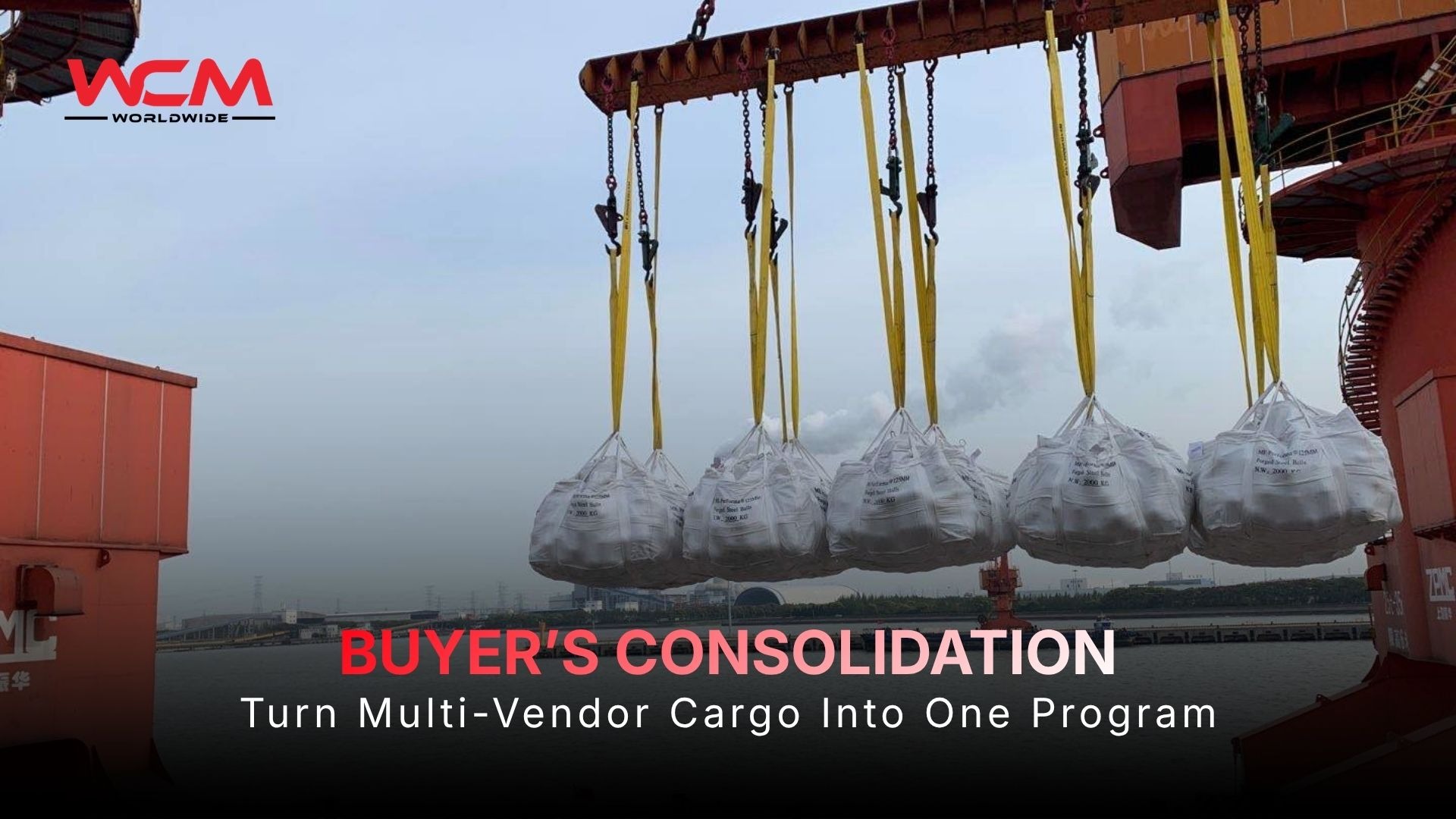
Buyer's consolidation combines cargo from multiple vendors at an origin consolidation point into full containers that the importer controls. Instead of paying for a stream of small LCL shipments that each carry their own handling, fees, and entries, the importer runs its inbound freight as one coordinated program. For US importers buying from many suppliers in the same origin region, it is usually the single largest untapped saving in the inbound supply chain.
Before structuring a buyer's consolidation program, a few practical factors decide whether the model will pay off:
- Number of vendors shipping from the same origin country or region
- Volume per vendor per shipment, particularly vendors shipping below full container loads
- Current spend on LCL freight, destination CFS fees, and per-shipment charges
- Order cadence and how vendor ready dates cluster across the calendar
- Purchase order visibility and the data discipline behind it
- Consolidation point selection relative to the vendor base
- Customs entry strategy for consolidated containers
- Destination distribution model, single DC or multi-node
The typical candidate profile is a US importer buying from ten, thirty, or a hundred suppliers across a sourcing region, with individual orders too small to fill a container. Left unmanaged, that flow becomes a stream of LCL shipments, each one touched by a forwarder, a co-loader, an origin CFS, a destination CFS, and a customs entry of its own. The freight invoices look small individually. The program cost is large and mostly invisible.
Buyer's consolidation reverses the structure. Vendors deliver cargo against purchase orders to a consolidation point the importer's freight partner operates, the cargo is loaded into full containers built for the importer, and the containers move under the importer's program to its distribution points. The importer stops buying freight shipment by shipment and starts running inbound capacity it controls.
WCM Worldwide operates buyer's consolidation for import and export cargo as a core capability of its FMC-licensed NVOCC ocean freight service.
What Buyer's Consolidation Actually Means
In a buyer's consolidation program, the importer, not the vendors and not a co-loader, controls the container. Suppliers deliver cargo to a nominated origin consolidation point against the importer's purchase orders. The consolidator receives, checks, and loads the cargo into containers dedicated to that importer, and the containers ship under the importer's freight program on the importer's routing.
This is structurally different from standard LCL. In LCL, a co-loader combines cargo from unrelated shippers into a shared container, and every shipper pays for the shared handling model at both ends. In buyer's consolidation, the only cargo in the box belongs to one importer, which means the importer captures the consolidation margin instead of paying it to a co-loader, and the container stuffing plan can follow the importer's receiving logic rather than a co-loader's cube optimization.
Control is the point. The importer decides which purchase orders ship in which container, in which sequence, to which destination. WCM operates this model with the consolidation plan driven by the importer's PO data, so the decision of what loads this week is a merchandising and inventory decision, not a freight default.
Where the Savings Actually Come From
The savings in buyer's consolidation are structural rather than negotiated. They come from removing cost layers that a fragmented LCL flow generates by design.
| Cost Dimension | Fragmented LCL Flow | Buyer's Consolidation |
|---|---|---|
| Ocean freight basis | LCL rates per shipment, each carrying co-loader margin | FCL rates under the importer's program |
| Destination handling | CFS deconsolidation fees on every shipment | Containers move intact to the importer's DC |
| Customs entries | One entry per shipment, fees multiplied | Consolidated entries per container or program |
| Cargo handling | Multiple touches at origin and destination CFS | Single stuffing at origin, single devanning at destination |
| Visibility | Shipment-level tracking across many house bills | PO-level visibility across one program |
Two second-order savings usually exceed expectations. Damage and claims fall because the cargo is touched fewer times between vendor and DC. And receiving labor at the destination falls because containers arrive stuffed in a sequence the DC planned, rather than as random LCL deliveries across the week.
WCM builds the savings case from the importer's actual invoice history before recommending the model, comparing twelve months of LCL, CFS, and entry charges against the consolidated structure. When the vendor base or cadence does not support the model, that finding is part of the analysis.
When Buyer's Consolidation Works and When It Does Not
The model has clear boundary conditions, and an honest program design starts with them.
Buyer's consolidation works when multiple vendors ship from the same origin region on a cadence that clusters, when individual vendor volumes are below container loads but the combined weekly or biweekly volume fills containers, and when the importer's purchase order data is reliable enough to plan against. Sourcing concentration in South China, the Yangtze delta, Southeast Asia, or the Indian subcontinent are the classic geographies, and the model applies equally to US export consolidation for overseas buyers.
The model struggles when vendors are scattered across origins with no clustering, when total regional volume cannot fill a container on an acceptable cadence, or when order timing is so irregular that consolidation would hold cargo for weeks waiting for a box to fill. Holding time is the hidden trade. A consolidation program that saves freight but adds two weeks of dwell has spent the saving on inventory.
WCM structures around these boundaries with mixed programs: consolidation where the vendor base clusters, direct FCL for vendors that fill their own containers, and conventional LCL as the exception lane for genuinely irregular cargo, all under one logistics program with one data view.
The Operating Model: PO Management, Vendor Compliance, and the Consolidation Point
A buyer's consolidation program runs on three operating disciplines, and the freight is the least demanding of them.
Purchase order management
The program plans against purchase orders, not against shipments. Every PO carries its vendor, ready date, quantity, cube, and destination, and the consolidation plan is built from that data. This is why PO management sits at the center of WCM's consolidation programs: the PO data is the operating system, and the containers are the output.
Vendor compliance
Vendors must book against POs inside defined windows, deliver to the consolidation point by cargo cutoff, and document cargo accurately at line level. Vendor compliance is where consolidation programs are won or lost, because one late vendor either delays the container or ships short. WCM manages vendor compliance through its origin offices, with booking discipline, cutoff enforcement, and exception reporting back to the importer's team in the same cycle.
The consolidation point
The consolidation point is selected against the vendor map, not the port map. The right facility sits inside the vendor cluster, receives and inspects cargo against the PO, reports discrepancies while there is still time to fix them, and stuffs containers to the plan. Where programs span borders, for example vendors across Southeast Asia feeding one consolidation point, the cross-border inbound legs are engineered into the program rather than left to each vendor.
Customs and Entry Strategy for Consolidated Cargo
Consolidated containers change the customs workload in the importer's favor, but only when the entry strategy is designed with the consolidation. Multi-vendor containers require entries that correctly reflect every PO line in the box, with classification, valuation, and origin maintained at line level. ISF filings must be complete and on time for every shipment in the program, and the data for all of it comes from the same PO records that drive the stuffing plan.
Run well, the structure reduces entry count, reduces per-entry fees, and gives the importer one consistent classification discipline across its vendor base instead of whatever each vendor's forwarder filed historically. Run badly, a single container can carry the documentation errors of ten vendors at once.
WCM integrates customs brokerage into the consolidation program so that the entry is prepared from the same PO and stuffing data that built the container. The classification file is maintained at the importer program level, and ISF timing is enforced by the same team that controls the cargo cutoffs.
Measuring the Program: KPIs for Inbound Consolidation
A consolidation program should be measured as a program, not as a series of shipments. Five measures capture whether the structure is delivering.
- Container utilization, the cube and weight achieved against container capacity across the program
- Vendor booking compliance, the percentage of POs booked and delivered inside their windows
- Landed cost per unit or per order, tracked against the pre-program LCL baseline
- Dwell time at the consolidation point, from cargo receipt to vessel departure
- Entry accuracy, the percentage of customs entries filed without post-entry correction
The baseline matters. The program's value is proven against what the fragmented flow actually cost, including the CFS fees, the per-entry charges, and the receiving labor that never appeared on a freight invoice. WCM reports these measures on a program cadence so the importer's team can see utilization, compliance, and landed cost moving quarter over quarter.
Why Buyer's Consolidation Programs Fail
Most buyer's consolidation problems are preventable. The common failures include:
- Launching the program without a validated PO data foundation, so the consolidation plan is built on ready dates no one maintains
- Skipping vendor onboarding and compliance discipline, leaving cutoffs unenforced and containers waiting on late cargo
- Selecting the consolidation point by port convenience rather than by the vendor cluster
- Chasing container utilization so hard that cargo dwells for weeks, spending the freight saving on inventory
- Leaving the customs entry strategy out of the program design, then discovering multi-vendor documentation errors container by container
- Running consolidation as a mandate for every vendor, including those that should ship direct FCL or stay in LCL
- Measuring the program on ocean freight rates alone, missing the CFS, entry, damage, and receiving labor lines where the savings actually sit
- Failing to re-baseline the program as the vendor base and order cadence change
These failures rarely appear as a single dramatic event. They compound. Weak PO data produces missed cutoffs, missed cutoffs produce half-full containers or long dwell, and the program quietly converges back toward the fragmented cost structure it was built to replace, while the reporting still calls it consolidation.
How WCM Worldwide Handles Buyer's Consolidation
WCM operates buyer's consolidation as a managed inbound program built on PO data, origin discipline, and integrated customs, not as a freight product.
- Program design built from the importer's invoice history and vendor map, with the savings case validated before launch against the hidden costs of the fragmented flow
- Vendor onboarding, booking windows, cargo cutoffs, and exception reporting managed through WCM origin offices inside the sourcing clusters
- Consolidation points selected against the vendor cluster, with receiving, inspection, and discrepancy reporting against the PO at cargo receipt
- Container stuffing plans driven by the importer's PO priorities and DC receiving logic rather than cube optimization alone
- FMC-licensed NVOCC ocean freight with service contracts across all major carriers carrying the consolidated containers under the importer's program
- Integrated customs brokerage preparing entries and ISF filings from the same PO and stuffing data that built each container
- Destination warehousing and distribution where the program needs devanning, sortation, or forward distribution beyond the importer's own DC
- Mixed program structures combining consolidation, direct FCL, and exception LCL under one data view, with quarterly reporting on utilization, compliance, dwell, and landed cost
- A global network of 496 offices in 97 countries, placing WCM teams inside the sourcing regions where the vendors and consolidation points actually sit
The value of this structure is that the PO data, the origin execution, the ocean program, and the customs work run inside one accountable team. WCM's leadership team carries 100+ years of combined experience built at FedEx Logistics, CEVA, COSCO, CMA CGM, and Kuehne+Nagel, including inbound program work for multi-vendor importers where the consolidation discipline determined the landed cost line. Buyer's consolidation is not a cheaper way to buy LCL. It is a different operating model for inbound freight.
Final Considerations for US Importers
Buyer's consolidation matters most when the vendor count is high, the origin region is concentrated, and individual orders are too small to fill containers. The inbound flow either runs as a program the importer controls, or it runs as a stream of small shipments whose true cost hides across freight, CFS, entry, damage, and receiving lines.
A practical checklist for evaluating whether your inbound flow is a consolidation candidate:
- Do ten or more vendors ship from the same origin region below full container volume?
- Does the combined regional volume fill containers on a weekly or biweekly cadence?
- Is PO data reliable enough to plan containers against ready dates?
- Have the last twelve months of LCL, CFS, and entry charges been totaled as one program cost?
- Is there a customs entry strategy designed for multi-vendor containers?
- Are utilization, compliance, dwell, and landed cost measured against a pre-program baseline?
If your inbound supply chain buys from many vendors across Asia or any concentrated sourcing region, the WCM ocean freight team can model a consolidation program against your current invoice history. The conversation typically starts with the vendor map, monthly order volumes, current LCL spend, and the destination distribution model.
Frequently Asked Questions
What is buyer's consolidation in ocean freight?
Buyer's consolidation is an inbound freight model in which cargo from multiple vendors is combined at an origin consolidation point into full containers controlled by the importer. Vendors deliver against the importer's purchase orders, the consolidator receives and loads the cargo into containers dedicated to that importer, and the containers move under the importer's own freight program. The importer captures the consolidation economics instead of paying LCL rates and destination CFS fees on a stream of small shipments.
How is buyer's consolidation different from LCL shipping?
In LCL, a co-loader combines cargo from unrelated shippers into shared containers, and every shipper pays for shared handling at an origin CFS and a destination CFS, plus the co-loader's margin inside the rate. In buyer's consolidation, every carton in the container belongs to one importer, the container moves intact to the importer's distribution center, and the stuffing plan follows the importer's receiving logic. The importer also gains PO-level control over what ships in which container and in what sequence, which LCL cannot offer.
How much can buyer's consolidation save compared to LCL?
The saving depends on the vendor base, order cadence, and current LCL spend, which is why a credible program starts by totaling twelve months of LCL freight, CFS fees, and per-entry customs charges as one baseline. The structural savings come from replacing per-shipment LCL rates with program FCL rates, eliminating destination CFS deconsolidation, reducing entry count, and cutting cargo handling touches. Second-order savings in damage reduction and DC receiving labor are frequently as large as the freight line itself.
What do vendors have to do differently in a consolidation program?
Vendors book against purchase orders inside defined booking windows, deliver cargo to the nominated consolidation point by the cargo cutoff, and document their cargo accurately at line level. Vendor compliance is the discipline that decides program performance, because one late or inaccurate vendor either delays a container or ships it short. A managed program includes vendor onboarding, cutoff enforcement, and exception reporting so the importer sees compliance problems as they happen rather than in the freight results.
How does customs clearance work for consolidated containers?
A multi-vendor container clears on entries that reflect every purchase order line in the box, with classification, valuation, and origin maintained at line level, and ISF filed completely and on time for each shipment. Done well, consolidation reduces entry count and gives the importer one consistent classification discipline across the vendor base. The protection is preparing entries from the same PO and stuffing data that built the container, so the documents describe exactly what is in the box.
When is buyer's consolidation not the right model?
The model struggles when vendors are scattered across origins with no regional clustering, when combined volume cannot fill containers on an acceptable cadence, or when order timing is so irregular that cargo would dwell for weeks waiting for a container to fill. Extended dwell converts freight savings into inventory cost. In those cases a mixed structure works better: direct FCL for vendors that fill their own containers, consolidation where the cluster supports it, and conventional LCL as the exception lane rather than the default.