The transpacific is the highest-volume project cargo corridor in the world for one structural reason: Asia fabricates what US capital projects install. Transformers, grid equipment, process modules, wind components, and mining machinery load in Chinese, Korean, and Japanese fabrication yards and discharge at US ports for projects that cannot start without them. The corridor has its own operational logic, and project cargo that is planned like a standard container booking absorbs that logic as schedule risk.
Before scoping a transpacific project cargo move, a few corridor-specific factors decide how the shipment should be structured:
- Direction of the move, since eastbound (Asia to US) and westbound (US to Asia) behave differently
- Cargo category across breakbulk, heavy lift, and out-of-gauge
- Vessel strategy: scheduled breakbulk liner service, multipurpose tramp, or full charter
- US discharge port capability for heavy lift and project cargo handling
- Pacific weather seasonality, including typhoon season and winter North Pacific conditions
- Tariff and trade policy exposure on Chinese-origin equipment
- Onward US inland leg across road, rail, or barge to the project site
- Fabricator readiness and the risk of load port delay at origin
The eastbound flow dominates. US grid modernization, energy projects, data center construction, and industrial reshoring all depend on capital equipment that is fabricated in Asia because that is where the heavy fabrication capacity sits. Large power transformers, pressure vessels, and pre-assembled modules routinely have no viable US-origin alternative at the required lead time.
Westbound project cargo is smaller in volume but no less demanding. US-manufactured equipment, aerospace and defense-adjacent cargo, and specialized machinery move from US ports to Asian and Pacific destinations, often under tighter regulatory control than the eastbound flow. Both directions share the same ocean, the same weather, and the same shortage of heavy lift capacity.
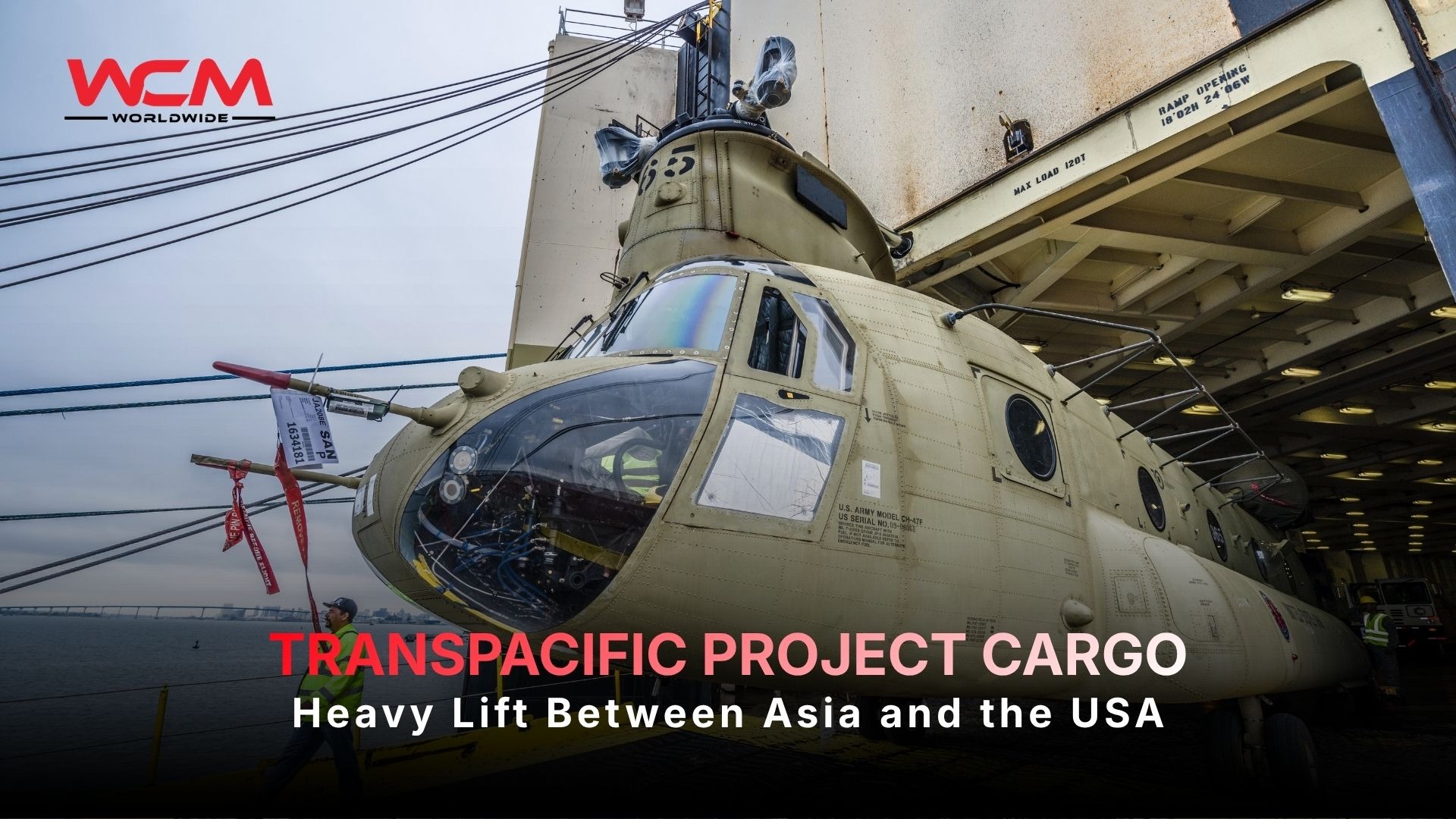
WCM Worldwide moves project cargo in both directions on the transpacific through its breakbulk and project cargo practice, including its signature move of firefighting Chinook helicopters across the Pacific.
Why the Transpacific Is a Different Project Cargo Corridor
Every project cargo corridor has its own constraints. The transpacific combines four that rarely appear together at this intensity: extreme distance, concentrated fabrication origins, a small set of viable US discharge ports for heavy cargo, and weather seasonality that closes routing options for parts of the year.
The distance matters commercially, not just operationally. A transpacific heavy lift voyage is a multi-week commitment of a scarce vessel, which means vessel owners price and schedule the corridor conservatively, and missed load windows are expensive to recover. A fabricator that slips two weeks at origin can push the cargo into a different vessel position, a different weather season, and a different discharge port queue.
Fabrication concentration cuts the other way. Because so much project cargo originates from a defined set of yards in China, South Korea, and Japan, the load ports are well understood, the surveyors and lashing gangs are experienced, and origin-side execution is more predictable than on most corridors. WCM runs its transpacific origin work through its own offices and long-standing agents in these fabrication clusters, which keeps load port coordination inside the same team that manages the ocean leg.
Eastbound: Asia to the USA, the Dominant Flow
The eastbound transpacific carries the capital equipment behind most large US industrial programs. Four cargo families define the flow.
- Large power transformers and grid equipment from Chinese, Korean, and Japanese manufacturers, moving as heavy lift with strict impact and tilt monitoring
- Process modules and pressure vessels for energy, chemical, and data center projects, often out of gauge in all three dimensions
- Wind energy components, including blades, nacelles, and tower sections, moving as breakbulk or on specialized carriers
- Mining and construction machinery, from crushers and mill components to complete mobile equipment
Eastbound execution risk concentrates at two points: fabricator readiness at origin and discharge port capability in the US. Fabrication yards work to their own production schedules, and the cargo is ready when it is ready. The freight plan has to absorb that uncertainty without losing the vessel position.
WCM manages eastbound moves by locking the cargo engineering data early, holding vessel options open across more than one load window where the fabricator schedule is uncertain, and running pre-shipment surveys at the yard before the cargo is declared ready. For mining equipment specifically, this eastbound flow connects directly into WCM's mining logistics programs that carry the cargo onward to remote US and Latin American sites.
Westbound: USA to Asia and the Pacific
The westbound flow carries US-manufactured and US-operated equipment to Asian and Pacific destinations: aerospace equipment, specialized vehicles, oil and gas components, agricultural machinery, and defense-adjacent cargo. The volumes are lower than eastbound, but the regulatory intensity is often higher, with export licensing, ITAR and EAR screening, and destination-country import controls all in scope.
Westbound moves also face a structural equipment problem. Heavy lift and multipurpose vessels position themselves around the dominant eastbound trade, so westbound project cargo often rides on repositioning legs or requires dedicated charter arrangements. Vessel choice on the westbound leg is a planning decision, not a booking decision.
WCM's most visible westbound reference is the movement of firefighting Chinook helicopters across the Pacific, a move that combined oversized aviation cargo, tight operational timelines, and specialized lift and lashing engineering. The same special projects discipline applies to any westbound cargo where the equipment is high-value, irregular, and operationally urgent at the destination.
Vessel Strategy: Liner Breakbulk, Multipurpose Tramp, or Charter
Three vessel strategies serve transpacific project cargo, and the right one depends on cargo profile, volume, and schedule tolerance.
Scheduled breakbulk and RoRo liner services connect the main Asian load ports with the US West Coast and, via canal routings, the Gulf and East Coast. They suit single pieces and moderate volumes that can flex to the published schedule. Multipurpose tramp tonnage suits fuller parcels and cargo that needs more flexible timing. Full or part charter becomes the right structure when the cargo volume, the piece weights, or the schedule certainty requirement exceed what liner and tramp options can hold.
The charter decision on the transpacific follows the same three forcing conditions that govern charter decisions generally: cargo characteristics beyond liner acceptance, project timing that cannot flex to carrier schedules, and total cost at volume. WCM structures this decision through its chartering desk, which identifies, negotiates, and fixes tonnage under the appropriate BIMCO forms, alongside its FMC-licensed NVOCC ocean freight service contracts that carry the supporting containerized cargo on the same corridor.
The practical discipline is to run the liner and charter options in parallel until the cargo readiness date firms up, rather than committing early to one structure and absorbing the risk that the fabricator schedule moves. Vessel strategy on this corridor is a decision to keep open as long as the market allows.
US Port Selection for Transpacific Project Cargo
US discharge port selection is one of the highest-leverage decisions on an eastbound move. The port has to handle the cargo physically, clear it administratively, and connect it to an inland route that can actually carry it to the project site. The nearest port to the project is frequently not the right port.
| Gateway | Project Cargo Strength | Inland Connection |
|---|---|---|
| Los Angeles / Long Beach | High-frequency liner and breakbulk services, deep heavy lift experience | Rail and road across the western states |
| Houston | The premier US project cargo and breakbulk port complex, heavy lift infrastructure | Gulf energy corridor, barge, rail, road |
| Seattle / Tacoma | Strong for machinery and OOG, shorter sailing from North Asia | Rail east, road across the Pacific Northwest |
| Oakland | Container-focused with project capability for moderate pieces | Northern California road and rail |
| Portland | Breakbulk and auto/RoRo capability, Columbia River barge access | Barge upriver, road and rail inland |
Heavy pieces bound for the interior often route through a port with barge or heavy rail access rather than the closest coastal gateway, because the inland leg is the binding constraint. WCM runs the port selection and the inland route survey as one combined analysis on its transpacific moves, so the discharge port is chosen against the route the cargo can actually travel, not against the sailing schedule alone.
Weather, Seasonality, and Schedule Risk on the Pacific
The Pacific imposes two seasonal constraints that project cargo planning has to respect. Typhoon season in the western Pacific runs from roughly June through November and affects load port operations, coastal routing, and schedule reliability out of Chinese, Korean, Japanese, and Southeast Asian ports. The winter North Pacific brings heavy weather on the great circle routes, which matters for deck-stowed OOG cargo and for lashing engineering on all breakbulk stows.
Weather risk on this corridor is managed in the planning, not in the voyage. Deck versus under-deck stowage decisions, lashing calculations against North Pacific winter criteria, weather routing services, and realistic buffer in the arrival window all belong in the freight plan before the cargo loads. A schedule built on fair-weather transit assumptions is a schedule that will be re-baselined.
WCM builds transpacific project schedules against the season the cargo will actually sail in, with stowage and lashing engineered for the route's weather criteria and arrival windows communicated to the project team as ranges with stated confidence rather than single dates.
Customs, Tariffs, and Trade Policy Exposure
Transpacific project cargo carries more trade policy exposure than almost any other corridor. Chinese-origin equipment faces Section 301 tariff exposure that can materially change the landed cost of a project, and classification, valuation, and origin determinations on large one-off capital equipment are more complex than on repetitive commercial goods. Antidumping and countervailing duty scope questions can also reach project equipment categories.
The planning consequence is that customs work on this corridor starts at the procurement stage, not at the arrival stage. Tariff classification and origin analysis belong in the total landed cost model before the purchase order is placed, because the difference between two sourcing options can exceed the entire freight budget. Entry strategy, bond sizing, and ISF filing then follow the cargo plan.
WCM runs customs brokerage inside the same workflow as the freight on its transpacific moves, with classification and entry planning built from the cargo engineering data sheet. On project cargo, where a single entry can carry very high value, that integration is a compliance control as much as a convenience.
Why Transpacific Project Cargo Shipments Fail
Most transpacific project cargo problems are preventable. The common failures include:
- Committing to a single vessel position before the fabricator schedule is firm, then losing the position when the cargo slips
- Selecting the US discharge port on sailing schedule alone, without running the inland route survey first
- Planning the voyage on fair-weather transit assumptions across typhoon season or the winter North Pacific
- Treating tariff classification and origin analysis as an arrival-stage task rather than a procurement-stage input
- Booking westbound cargo as if vessel availability mirrors the eastbound trade
- Leaving pre-shipment surveys at the fabrication yard until the cargo is declared ready, discovering packaging or lifting point issues at the quay
- Splitting the ocean leg, customs work, and US inland leg across vendors with no shared cargo data
- Under-engineering lashing and stowage for deck-carried OOG cargo on the North Pacific
These failures rarely appear as a single dramatic event. They compound. A fabricator slip combines with a lost vessel position, a discharge port that was never surveyed against the inland route, and a tariff exposure discovered at entry, and the project absorbs weeks of delay and unplanned landed cost before any single decision is identified as the cause.
How WCM Worldwide Handles Transpacific Project Cargo
WCM operates the transpacific as a core project cargo corridor, with origin, ocean, customs, and US inland execution held inside one accountable team.
- Origin coordination through WCM offices and long-standing agents in the Chinese, Korean, and Japanese fabrication clusters, including pre-shipment surveys at the yard
- Cargo engineering data sheets with formal revision control, used as the single source of truth across stowage, lashing, customs, and inland planning
- Vessel strategy run across scheduled breakbulk liner services, multipurpose tramp tonnage, and full or part charter, with options held in parallel until cargo readiness firms up
- Chartering desk capability to identify, negotiate, and fix tonnage under HEAVYCON, HEAVYLIFTVOY, and GENCON forms when the move requires dedicated capacity
- US discharge port selection combined with the inland route survey as one analysis, covering heavy lift capability, barge and rail access, and permit lead times
- Stowage and lashing engineered against the actual sailing season, including North Pacific winter criteria for deck-carried cargo
- Integrated customs brokerage with classification, origin analysis, and entry planning built from the cargo data sheet and started at the procurement stage
- FMC-licensed NVOCC ocean freight service contracts carrying the supporting containerized cargo on the same corridor as the project pieces
- A global network of 496 offices in 97 countries, with coverage on both sides of the Pacific rather than only at the US end
The value of this structure is that fabricator coordination, vessel strategy, customs, and the US inland leg share one cargo data set and one accountable owner. WCM's leadership team carries 100+ years of combined experience built at FedEx Logistics, CEVA, COSCO, CMA CGM, and Kuehne+Nagel, including the transpacific movement of firefighting Chinook helicopters, a move that demanded exactly this integration of engineering, vessel work, and regulatory execution. Transpacific project cargo behaves better when the team running it has already worked both ends of the ocean.
Final Considerations for Project Owners and EPC Teams
Transpacific project cargo matters most when the project's critical path runs through equipment that only Asian fabrication capacity can supply, or when US-built equipment has to reach a Pacific destination on an operational deadline. The corridor rewards early planning and punishes booking-stage improvisation.
A practical checklist for evaluating a planned transpacific project cargo move:
- Is the vessel strategy being held open across liner, tramp, and charter options until the fabricator schedule is firm?
- Has the US discharge port been selected against the inland route survey, not just the sailing schedule?
- Is the voyage planned against the actual sailing season, including typhoon season and winter North Pacific criteria?
- Was tariff classification and origin analysis completed before the purchase order was placed?
- Are pre-shipment surveys scheduled at the fabrication yard before the cargo is declared ready?
- Do the ocean leg, customs work, and US inland leg share one cargo data sheet and one accountable owner?
If your project depends on capital equipment crossing the Pacific in either direction, the WCM project cargo team can review your move against the framework above. The conversation typically starts with cargo specifications, the fabrication or manufacturing schedule, the intended ports, and the project arrival window.
Frequently Asked Questions
What is transpacific project cargo?
Transpacific project cargo is heavy lift, breakbulk, and out-of-gauge equipment moving between Asia and the Americas across the Pacific Ocean. The dominant flow is eastbound, carrying transformers, grid equipment, process modules, wind components, and mining machinery from Chinese, Korean, and Japanese fabrication yards to US ports. The westbound flow carries US-manufactured equipment, aerospace cargo, and specialized machinery to Asian and Pacific destinations. The corridor combines extreme distance, concentrated fabrication origins, a limited set of heavy-capable US ports, and strong weather seasonality.
Which US ports handle transpacific project cargo best?
Houston is the premier US project cargo and breakbulk complex, reached from Asia via canal routings, with deep heavy lift infrastructure and Gulf energy corridor connections. On the West Coast, Los Angeles and Long Beach combine high-frequency services with heavy lift experience, Seattle and Tacoma offer shorter sailings from North Asia with strong rail connections, and Portland provides Columbia River barge access for heavy pieces moving inland. The right port depends on the inland route the cargo can actually travel, which is why port selection and the inland route survey should be run as one analysis.
When should transpacific project cargo move on a charter instead of liner service?
Charter becomes the right structure when cargo characteristics exceed liner acceptance, when project timing cannot flex to published carrier schedules, or when the total volume makes dedicated tonnage economical. Scheduled breakbulk and RoRo liner services handle single pieces and moderate volumes well, and multipurpose tramp tonnage covers fuller parcels with flexible timing. The practical discipline is to run liner and charter options in parallel until the fabricator schedule firms up rather than committing early and absorbing the schedule risk.
How does typhoon season affect transpacific project cargo?
Typhoon season in the western Pacific runs from roughly June through November and affects load port operations, coastal routing, and schedule reliability out of Asian ports. The winter North Pacific separately brings heavy weather on the main transit routes, which drives stowage and lashing decisions for deck-carried and out-of-gauge cargo. Both constraints are managed in planning rather than in the voyage, through stowage engineering, weather routing, and realistic arrival windows built for the season the cargo will actually sail in.
What tariff issues apply to project cargo from China?
Chinese-origin capital equipment can face Section 301 tariff exposure, and classification, valuation, and origin determinations on large one-off equipment are more complex than on repetitive commercial goods. Antidumping and countervailing duty scope questions can also reach project equipment categories. Because the tariff impact can exceed the entire freight budget, classification and origin analysis belong in the total landed cost model at the procurement stage, before the purchase order is placed, with entry strategy and bond planning following the cargo plan.
How far in advance should a transpacific project cargo move be planned?
Planning should begin 90 to 180 days before the cargo is ready to ship, and the longer end of that range is typical when the move requires charter tonnage, when the US inland leg needs permits and route surveys, or when the sailing window falls in typhoon season or the winter North Pacific. Cargo engineering, vessel strategy, customs analysis, and the US inland plan run in parallel from the engineering stage. Moves that start planning at the booking stage rarely recover the lead time on this corridor.