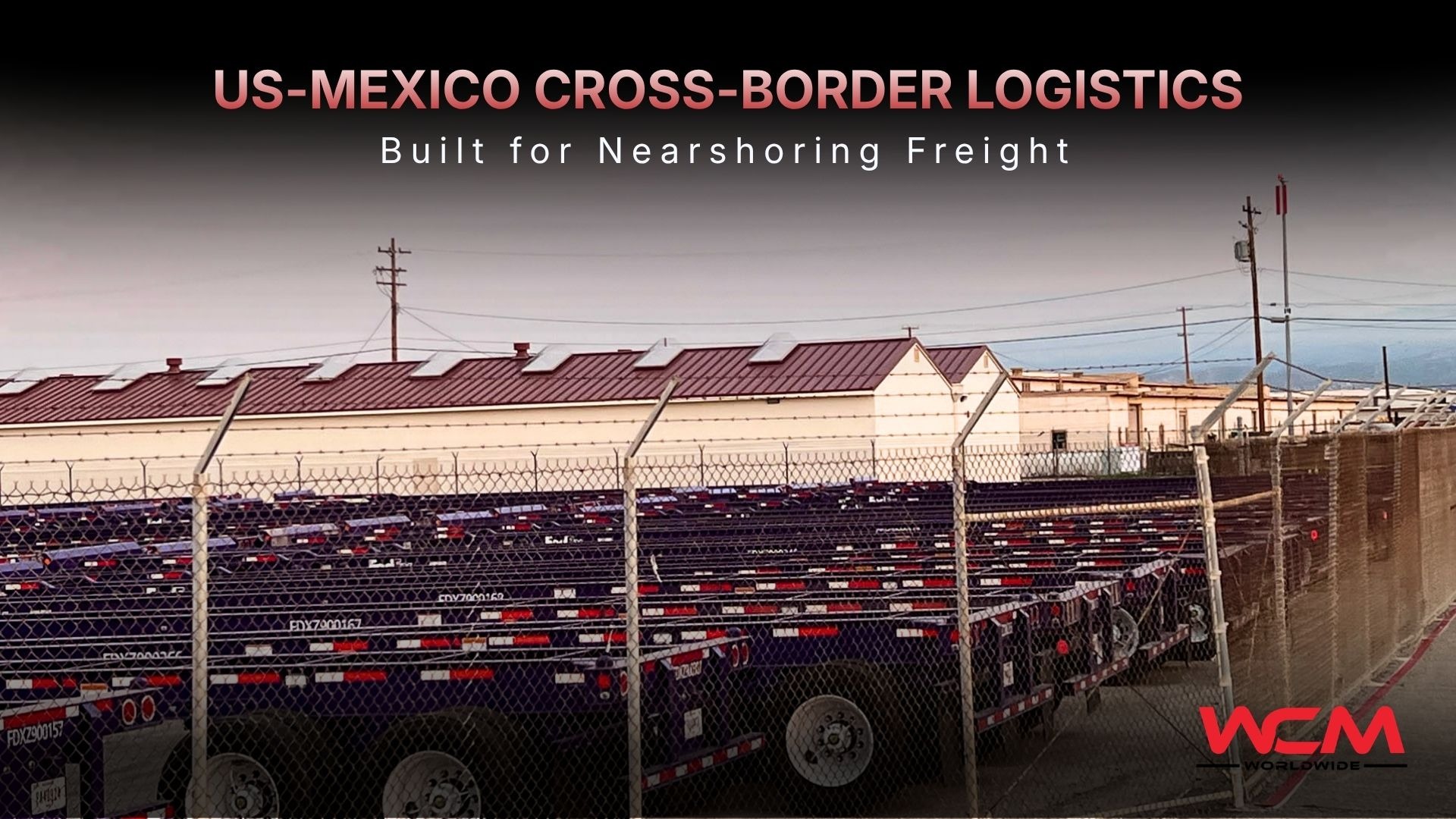
Nearshoring moves production closer, but it does not make the freight simpler. It converts a weekly ocean flow into a daily overland flow across one of the busiest trade borders in the world, with two customs regimes, two carrier markets, and a handoff structure that most freight programs built for Asia have never had to manage. The companies winning on nearshoring are the ones that redesigned the freight program instead of pointing the old one at a new origin.
Before shifting sourcing or production to Mexico, a few cross-border factors decide how the freight program should be structured:
- Production locations in Mexico relative to the major border crossings
- Cadence of the flow, from daily truckload programs to weekly consolidated moves
- Mode structure across direct truckload, transload at the border, and intermodal rail
- Broker structure on both sides, since Mexican exports generally require a licensed Mexican customs broker
- USMCA qualification and the documentation discipline behind preferential entries
- Border crossing selection and the variability of crossing times
- Where inventory buffers sit, at the plant, at the border, or at the US distribution point
- Visibility across the handoffs from Mexican carrier to border to US carrier
The structural shift is cadence. An Asia program moves in vessel-sized weekly pulses with weeks of transit to plan around. A Mexico program moves daily, with transit measured in days, which means less inventory in motion and far less slack in the schedule. Every disruption that an ocean program absorbed inside its transit buffer now lands directly on the production or fulfillment calendar.
The second shift is that the border is not a line the truck drives across. It is a sequence of regulated events: a Mexican export clearance, a physical crossing, a US entry, and in many programs a carrier change and a transload in the middle. Each event has its own documents, parties, and failure modes, and the program design decides whether they run as one flow or as a daily improvisation.
WCM Worldwide builds and operates US-Mexico freight programs through its cross-border solutions practice, with the stated discipline of taming the border before the cargo gets there.
Why Nearshoring Rewrites the Freight Program
A freight program is shaped by its geography. When the origin moves from Asia to Mexico, almost every design parameter changes at once: transit drops from weeks to days, shipment size drops from containers to truckloads, the ocean carrier relationship is replaced by two trucking markets and a border, and the customs workload doubles because every move is both an export and an import.
The opportunity is real. Shorter transit means less capital tied up in inventory, faster response to demand, and the ability to run production and fulfillment on tighter cycles. But the opportunity is captured in the program design, not in the geography. A nearshored supply chain running on an unmanaged border delivers Asia-style unpredictability at overland cost.
WCM approaches nearshoring engagements as program design work first: mapping the plants, the crossings, the modes, and the broker structure before any freight moves, so the border behaves as a scheduled process rather than a daily variable.
The Border Is a Process, Not a Line
Every northbound move is two regulated transactions. Mexico treats the departure as an export, generally requiring a licensed Mexican customs broker and the export documentation that goes with it. The United States treats the arrival as an entry, with classification, valuation, and admissibility requirements identical in seriousness to any ocean import. The truck in between is the simple part.
The handoff structure varies by program. In the most common model, a Mexican carrier hauls to the border, a drayage operator shuttles the trailer across, and a US carrier picks up on the other side, sometimes with a transload between trailers. Every handoff is a scheduling event, a liability transfer, and a data transfer, and the border wait itself varies by crossing, by day, and by inspection activity on both sides.
WCM coordinates both sides of this process as one flow: the Mexican broker relationship, the US customs brokerage entry, and the carrier handoffs are sequenced against each other so that documents are cleared before trailers arrive at the crossing rather than after. That is what taming the border before you get there means in practice: the cargo should never be waiting on its paperwork.
Mode Choices: Direct Truckload, Transload, and Intermodal Rail
Three mode structures carry most US-Mexico freight, and the right one depends on volume, cadence, cargo profile, and how far into the US the freight travels.
| Mode Structure | Best Fit | Trade-Offs |
|---|---|---|
| Direct truckload, through-trailer | Time-sensitive freight, tight production schedules, shorter US legs | Highest cost per load, depends on cross-border carrier arrangements |
| Transload at the border | Programs balancing cost and flexibility, mixed carrier bases | Added handling and dwell at the border, requires disciplined transload operations |
| Intermodal rail | High steady volume moving deep into the US interior | Longer transit than truck, fixed rail schedules, terminal drayage at both ends |
Most enterprise programs end up mixed: direct truckload for the production-critical lanes, transload for the general flow, and rail for the steady high-volume legs into the US interior. The mix is a design decision that should be revisited as volumes mature, because the right answer at program launch is rarely the right answer two years in.
WCM structures these programs mode by mode and lane by lane, and where the nearshored flow connects to an international leg, ocean or air freight beyond North America, the cross-border program plugs into the same integrated freight operation rather than running as a separate silo.
USMCA and the Compliance Layer
USMCA preferential treatment is one of the core economics of nearshoring, and it is earned, not automatic. Goods qualify under rules of origin that vary by product, qualification must be supported by a certification of origin, and the importer claiming the preference carries the documentation burden if CBP asks. A program claiming preferences it cannot support has converted a duty saving into a penalty exposure.
The operational discipline is unglamorous: maintain the qualification analysis per product, keep certifications current as suppliers and inputs change, and make sure the classification and valuation filed on each entry match the records behind the certification. On daily-cadence programs, this is a volume problem, because a small documentation error repeats itself hundreds of times before anyone notices.
WCM builds the compliance layer into the program rather than alongside it. The same customs brokerage team that files the entries maintains the classification file and the certification records, and compliance metrics are reported with the freight metrics so a documentation drift is visible in weeks rather than discovered in an audit.
Where Freight Programs Get Stuck at the Border
Cross-border delay has a small number of recurring causes, and almost all of them are visible upstream of the crossing.
Documents trailing the truck
The trailer arrives at the border before its export clearance or entry data is complete, and it waits. On a daily program, a documentation process that runs even half a day behind the trucks turns the border into a rolling queue. The fix is sequencing: clearance processes triggered at shipment tender, not at border arrival.
Broker handoffs without shared data
The Mexican broker, the US broker, and the carriers each work from their own copies of the shipment data. Discrepancies between the export documents and the entry surface at the worst possible point, the crossing itself. The fix is one shipment record feeding both sides.
Transload operations without discipline
Freight transloaded at the border is counted, checked, and reloaded. Done well, this is a quality checkpoint. Done loosely, it is where shortages, damage, and mislabeled pallets enter the program, and where they are discovered weeks later at the US destination. The fix is treating the transload as a controlled receiving operation with its own metrics.
Crossing selection by habit
Programs default to the crossing they started with, even as volumes and destinations change. Laredo carries the largest share of US-Mexico truck freight for good reasons, but plant location, US destination, and congestion patterns can make other gateways the better answer for specific lanes. The fix is reviewing crossing selection as part of the program cadence rather than treating it as fixed infrastructure.
Designing the Cross-Border Program
A cross-border program that runs well has been designed as a system: named lanes with defined modes, a broker structure with shared data, buffer inventory placed deliberately, and metrics that treat the border as a managed process.
- Lane design: each plant-to-destination pair assigned a mode structure, a crossing, and a target cycle time
- Broker structure: Mexican and US brokerage sequenced on one shipment record, with pre-clearance wherever the program qualifies
- Buffer strategy: inventory positioned at the plant, the border, or the US node by design, sized against crossing variability
- Visibility: milestone tracking across tender, export clearance, crossing, entry, and delivery, not just truck GPS
- Metrics: crossing dwell, documentation exceptions, USMCA claim accuracy, and cycle time reliability reported on a program cadence
Where the program needs physical infrastructure on the US side, border-area or destination-market warehousing and distribution, WCM integrates it into the same program design, so the buffer strategy and the freight design are decided together rather than separately.
Why US-Mexico Cross-Border Programs Fail
Most cross-border freight problems are preventable. The common failures include:
- Pointing an Asia-built freight program at a Mexican origin without redesigning cadence, modes, or broker structure
- Running documentation processes that trail the trucks, converting the border into a rolling queue
- Operating Mexican and US brokerage from separate copies of the shipment data
- Claiming USMCA preferences without maintained qualification analysis and current certifications
- Treating the transload as a pass-through instead of a controlled receiving operation
- Selecting border crossings by habit rather than by lane economics and congestion patterns
- Sizing inventory buffers for ocean-era variability, or removing them entirely, instead of sizing them against actual crossing data
- Measuring truck transit while leaving crossing dwell, documentation exceptions, and claim accuracy unmeasured
These failures rarely appear as a single dramatic event. They compound. A documentation process that trails the trucks meets a broker handoff without shared data, the crossing dwell stretches, the buffer that was never sized for it runs dry, and the production line the nearshoring move was meant to protect goes down for want of a trailer that has been sitting at the border since morning.
How WCM Worldwide Handles US-Mexico Cross-Border Logistics
WCM builds cross-border programs as designed systems, with both sides of the border, the modes, and the compliance layer run as one accountable operation.
- Program design through WCM's cross-border solutions practice: lanes, crossings, modes, and broker structure mapped before freight moves
- Coordinated Mexican and US brokerage on one shipment record, with clearance processes triggered at tender so documents clear before trailers arrive
- US entries, classification files, and USMCA certification records maintained by WCM's integrated customs brokerage with compliance metrics reported alongside freight metrics
- Mixed mode structures across direct truckload, border transload, and intermodal rail, assigned lane by lane and revisited as volumes mature
- Transload operations run as controlled receiving, with counts, condition checks, and exception reporting at the border
- Border-area and destination-market warehousing and distribution integrated into the buffer strategy where the program needs it
- Milestone visibility across tender, export clearance, crossing, entry, and delivery, with crossing dwell and documentation exceptions measured on a program cadence
- Connection into WCM's international ocean freight and multimodal operations where the nearshored flow feeds or draws from lanes beyond North America
- A global network of 496 offices in 97 countries behind the program, so a supply chain that is nearshoring from Asia can run its transition and its steady state through one operator
The value of this structure is that the border behaves as a scheduled process inside one program rather than a daily negotiation between vendors. WCM's leadership team carries 100+ years of combined experience built at FedEx Logistics, CEVA, COSCO, CMA CGM, and Kuehne+Nagel, across freight programs where cadence, compliance, and carrier structure had to be redesigned rather than inherited. Nearshoring succeeds as a freight strategy when the program is built for the border it actually crosses.
Final Considerations for Supply Chain and Procurement Leaders
Cross-border program design matters most when nearshored volume is ramping, production schedules are tight, and the duty economics depend on USMCA preferences that must be documented. The freight either runs as a designed system across both sides of the border, or it accumulates dwell, exceptions, and compliance exposure one trailer at a time.
A practical checklist for evaluating a current or planned US-Mexico freight program:
- Has the program been designed for daily overland cadence rather than inherited from an ocean-era structure?
- Do the Mexican and US brokers work from one shipment record with clearance triggered at tender?
- Is the mode mix assigned lane by lane and reviewed as volumes change?
- Is USMCA qualification maintained per product with current certifications behind every claim?
- Are transloads run as controlled receiving operations with their own metrics?
- Are crossing dwell, documentation exceptions, and cycle time reliability measured on a program cadence?
If your organization is nearshoring production to Mexico or scaling an existing cross-border flow, the WCM cross-border team can review your program design against the framework above. The conversation typically starts with plant locations, lane volumes, current crossing performance, and the USMCA position of the product range.
Frequently Asked Questions
How does nearshoring to Mexico change a freight program?
Nearshoring converts a weekly ocean flow with weeks of transit into a daily overland flow with days of transit. Shipment sizes drop from containers to truckloads, the ocean carrier relationship is replaced by carrier markets on both sides of the border, and every move becomes both a Mexican export and a US import, doubling the customs workload. The shorter transit removes inventory from the pipeline but also removes the buffer that absorbed disruptions, so the freight program has to be redesigned for the new cadence rather than pointed at the new origin.
What happens at the US-Mexico border on a northbound freight move?
A northbound move is a sequence of regulated events rather than a single crossing. Mexico processes the departure as an export, generally through a licensed Mexican customs broker, and the United States processes the arrival as an entry with full classification, valuation, and admissibility requirements. In the most common operating model, a Mexican carrier hauls to the border, a drayage operator shuttles the trailer across, and a US carrier continues the move, sometimes with a transload between trailers. Well-run programs clear the documents before the trailer arrives so the cargo is never waiting on its paperwork.
Should cross-border freight move by direct truckload, transload, or rail?
Direct through-trailer truckload suits time-sensitive freight and tight production schedules, at the highest cost per load. Transloading at the border balances cost and flexibility and doubles as a quality checkpoint when the operation is disciplined, at the price of added handling and dwell. Intermodal rail suits high steady volumes moving deep into the US interior, with longer transit and fixed schedules. Most enterprise programs run a mix, assigned lane by lane, and revisit the mix as volumes mature because the right structure at launch is rarely the right structure two years in.
What is required to claim USMCA preferential treatment?
Goods must qualify under the USMCA rules of origin applicable to the specific product, and the claim must be supported by a certification of origin with the importer carrying the documentation burden if CBP reviews it. Qualification is not automatic and must be maintained as suppliers, inputs, and sourcing change. On daily-cadence cross-border programs the discipline is a volume problem: classification, valuation, and certification records must stay consistent across hundreds of entries, because a small recurring error repeats itself many times before an audit finds it.
Which border crossing should a US-Mexico freight program use?
Laredo carries the largest share of US-Mexico truck freight and anchors most programs, but the right crossing for a given lane depends on plant location in Mexico, the US destination, the mode structure, and congestion patterns that shift over time. Rail programs are constrained to the rail gateways, and transload programs need crossings with strong transload infrastructure. Crossing selection should be treated as a program design variable reviewed on a regular cadence, not as fixed infrastructure inherited from the program's first month.
Where should inventory buffers sit in a nearshored supply chain?
Buffers can sit at the Mexican plant, at the border, or at the US distribution node, and the right placement is a design decision sized against actual crossing variability rather than ocean-era habits. Placing all the buffer at the US node protects fulfillment but ties up the most capital, while running with no buffer exposes production to every crossing delay. Many programs hold a small border-area buffer precisely because the crossing is the highest-variability link, then thin it as measured crossing performance stabilizes.